
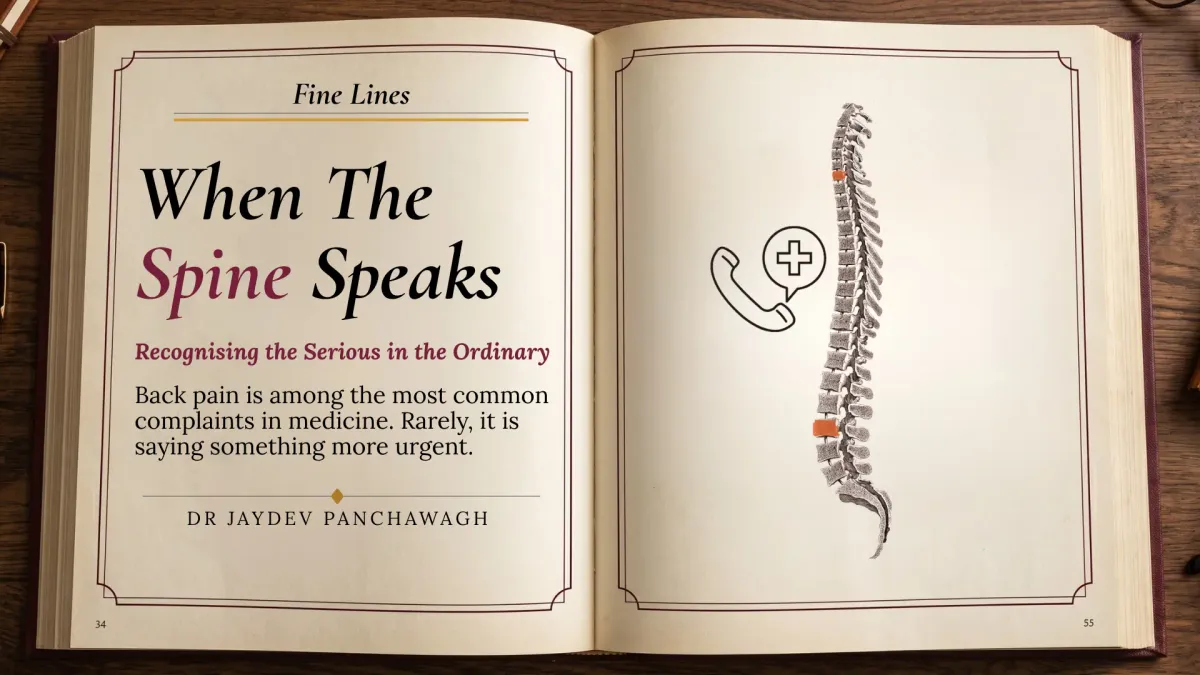
“Most back pain is harmless, and most of the time dismissing it is the right call. But certain patterns — pain that wakes you at night, pain after a fall, pain that travels down a limb — mean something different. This essay is about learning to recognise those patterns before it is too late.”
— Dr Jaydev Panchawagh · Neurosurgeon, Pune
The Complaint
Back pain, neck pain and sciatica: why “common” does not always mean “safe”
In our sedentary, screen-bound age, back pain has become an almost universal complaint. Many of us will know low back pain or neck pain at some point — some passingly, some intimately. The software engineer hunched over a laptop. The homemaker on her feet from dawn to dusk. The commuter jolting over rutted roads on a two-wheeler. The farmer bent low over the earth. Spinal pain spares no occupation and no class.
And precisely because it is so common, it is often dismissed. A little balm. A tablet. It will pass. Most back pain is indeed harmless — a transient protest from overworked muscle. But occasionally, hidden inside that ordinary ache, there is something else: a slipped disc, a pinched nerve, an infection or, sometimes, a tumour. Some patients reach a spine clinic late because what began as an inconvenience proved to be disease. Knowing the difference matters.
The Ordinary Ache
What is mechanical back pain? Causes, symptoms and how it resolves
Let us begin with the kind of back pain that is exactly what it seems.
You played a hard game of cricket on Sunday. You hauled a refrigerator up three flights of stairs. You bent awkwardly to lift a child, sat through a long meeting in a poorly designed chair, or skipped your warm-up before a morning run. The paraspinal muscles and ligaments — the soft-tissue scaffolding of the spine — may be strained. A muscle can go into spasm. Local inflammation follows, and pain registers. This is commonly described as mechanical or non-specific back pain, and it accounts for a large proportion of cases.
This kind of pain often has a familiar arc. It may be worst during the first day or two and gradually soften. A warm-water bag may bring relief; heat can relax muscles and ease discomfort. Gentle activity, appropriate pain relief under medical advice, and a guided exercise or physiotherapy programme may help. Many episodes improve over days to a few weeks.
This is not usually the back pain that should cause alarm. The important word is usually: persistent, severe or unusual symptoms deserve assessment rather than assumptions.
The Warning Signs
Red flags in back pain: pain after injury, night pain, fever and weight loss — and why each one matters
The trouble begins when pain carries certain warning signs — what physicians call red flags. These can point towards more serious spinal problems, including fracture, infection, malignancy or significant nerve compression. Recognising them can help a patient seek timely evaluation.
Pain after trauma. A fall from a height, a road accident or a direct blow to the spine should not be ignored, particularly when pain is severe, persistent or worsening. Vertebral compression fractures can sometimes be subtle. A clinician may recommend imaging, such as an X-ray or MRI, based on the history and examination.
Pain that wakes you at night. Ordinary mechanical back pain may ease when you lie down. Persistent pain that is not relieved by rest or changes in posture, and repeatedly disrupts sleep, needs assessment. Depending on the full clinical picture, possibilities can include inflammatory disease, spinal infection or a tumour.
Fever with back pain. The combination can indicate infection, including tuberculosis of the spine (Pott’s disease), discitis or vertebral osteomyelitis. Fever and spinal pain occurring together warrant prompt medical evaluation.
Unintended weight loss. When unexplained weight loss accompanies persistent back pain, the two should be considered together. Underlying malignancy, including spread to the spine from another cancer, is one possibility that a doctor may need to investigate.
Relevant medical history. A previous cancer, osteoporosis, older age or other risk factors can change how apparently simple back pain should be assessed. Osteoporotic vertebrae may fracture after relatively minor strain or movement.
A diagnosis arrived at this way is not a sentence. It is a map. It tells you and your physician where you are, and what paths lie ahead.
The Nervous System
Sciatica, slipped disc and cervical spondylosis: when pain radiates down the arm or leg
There is another category of warning — subtler, and often more consequential — that arises from the nervous system itself.
The spine is not merely a column of bone. The spinal cord runs through its central canal, and at each vertebral level nerve roots emerge through openings between the vertebrae to supply the limbs and trunk. When a disc herniates — a slipped disc or disc prolapse — or degenerative changes such as cervical or lumbar spondylosis narrow the channels through which nerves pass, pressure can develop on neural tissue. Significant narrowing is called spinal stenosis. Pressure on a nerve may produce symptoms along its distribution, a pattern clinicians call radiculopathy.
So we listen for symptoms that travel.
Pain that begins in the neck and radiates down the arm may indicate cervical radiculopathy. Pain from the lower back through the buttock and down the leg is commonly called sciatica, often associated with irritation or compression of a lumbar nerve root. Tingling, numbness, a leg that feels weak when climbing stairs or a foot that drags against the floor — sometimes called foot drop — also deserve clinical attention.
And there are symptoms that cannot wait: new loss of bladder or bowel control, rapidly progressive weakness in both legs, or numbness around the saddle area (the inner thighs, buttocks or groin). These can indicate cauda equina syndrome or another serious neurological problem. Seek emergency medical assessment immediately; do not try to manage these symptoms at home.
The Evaluation
Diagnosing serious back pain: MRI, clinical examination and treatment options
When a physician calls a pain serious, it does not mean catastrophic. It means worth examining, worth investigating and worth ruling out.
Not every red flag indicates cancer. Not every spine in pain is diseased. But the way to understand the problem is to evaluate it: is this an ordinary ache, or the presentation of something else?
In a neurosurgical or spine clinic, the work begins with a careful clinical examination. This may include observation of gait, tendon reflexes, pinprick and light-touch testing, manual muscle testing and specific manoeuvres such as the straight-leg-raise test. The findings guide further investigations. Depending on the case, these may include an X-ray of the cervical or lumbar spine, an MRI to assess discs, nerves and spinal cord, blood tests for inflammation or infection, serum calcium and vitamin D, or a bone-density (DEXA) study. Other tests are considered when clinically indicated.
Technology serves the question raised by the clinical findings. It does not replace them. A diagnosis arrived at this way is not a sentence. It is a map — one that helps the patient and physician consider the available paths, whether conservative treatment with physiotherapy and medication, an image-guided injection, or, in selected cases, spine surgery.
The Reflection
When to see a neurosurgeon for back pain — listening to the body before it speaks louder
Back pain is so woven into modern life that we have grown almost casual about it. And most of the time, this casualness is justified. The pain comes; the pain goes; life resumes.
But the body speaks in more than one register. Sometimes it murmurs. Sometimes it warns. The art of looking after one’s own spine lies in learning to tell the two apart.
Do not panic at pain. Do not, equally, dismiss it.
Watch for the red flags. And when one appears, act on it.
Frequently Asked Questions
Back pain, sciatica and spine surgery: common questions answered
When is back pain serious and when should I see a doctor?
Many episodes of back pain are mechanical and improve over time. See a doctor if pain follows significant trauma, repeatedly wakes you at night, occurs with fever or unexplained weight loss, radiates into an arm or leg, or is associated with numbness or weakness. New bladder or bowel-control problems or saddle-area numbness require emergency assessment.
What is sciatica?
Sciatica is pain that radiates from the lower back through the buttock and down the leg along the path of the sciatic nerve. It is often associated with irritation or compression of a lumbar nerve root, sometimes due to a slipped disc. Tingling, numbness or weakness may also occur.
What is a slipped disc?
A slipped disc, also called disc herniation or disc prolapse, occurs when material from the inner part of an intervertebral disc protrudes through its outer ring. It may press on a nearby spinal nerve and cause back or neck pain, radiating pain, tingling, numbness or weakness.
What is cervical spondylosis?
Cervical spondylosis is age-related degeneration of discs and joints in the neck. It can cause neck pain and stiffness, or pain radiating towards the shoulder or arm. In some cases, spinal-cord compression (cervical myelopathy) can lead to weakness, hand-coordination difficulties or balance problems.
Can back pain be a sign of cancer or tuberculosis?
Yes, although these are not the most common causes of back pain. Persistent pain, particularly when accompanied by night pain, fever, weight loss or a past history of cancer, may prompt investigation for spinal tuberculosis, another infection or metastatic disease. Assessment may include MRI and blood tests.
What is cauda equina syndrome?
Cauda equina syndrome is a serious condition caused by compression of nerve roots at the lower end of the spinal canal. Symptoms can include numbness in the saddle area, new bladder or bowel dysfunction and weakness in the legs. It requires immediate emergency medical assessment.
What tests are done to diagnose back pain?
Testing depends on the symptoms and examination. A doctor may recommend an X-ray, MRI, blood tests for inflammation or infection, calcium and vitamin D tests, or a DEXA bone-density scan where osteoporosis is a concern. Not everyone with back pain needs imaging.
When is spine surgery necessary?
Most back pain does not require surgery. Surgery may be considered for significant nerve compression with progressive weakness, cauda equina syndrome, selected unstable fractures, spinal infection or tumour, or persistent disabling symptoms from a structural problem despite appropriate non-surgical treatment. The decision depends on individual assessment.
How can I prevent back pain?
Regular activity, appropriate strengthening, varied posture and safe lifting habits may help support spinal health. Avoid remaining in one position for prolonged periods; take movement breaks, maintain a healthy weight and discuss individual exercise or nutrition needs with a healthcare professional.
Continue Reading
When the Spine Speaks
Recognising the symptoms that may signal a problem involving the spine and nervous system.
Read More →
The Tumour That Stole His Steps
A story about a brain tumour, changing symptoms and the path to diagnosis.
Read More →
The Pain Nobody Believed
Why persistent symptoms deserve careful evaluation and a search for their cause.
Read More →


