
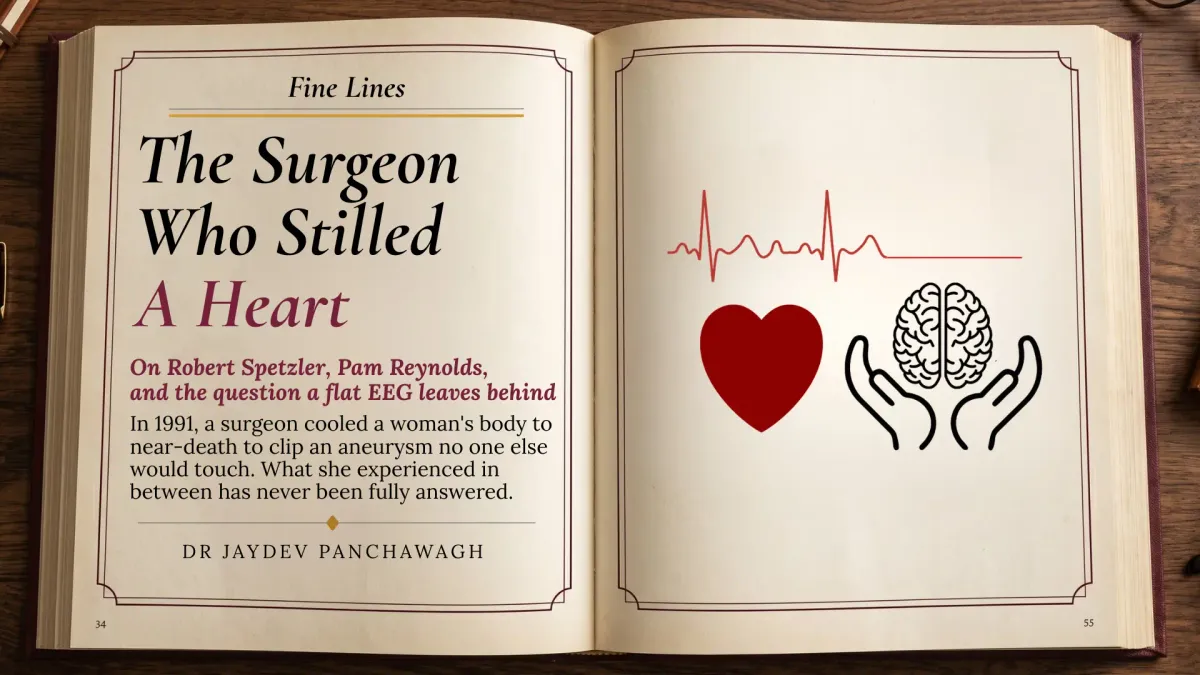
In 1991, neurosurgeon Robert Spetzler undertook an operation that required the patient's circulation to be stopped temporarily so that a giant aneurysm at the tip of the basilar artery could be treated. The patient, Pam Reynolds, later described experiences from the operation that continue to raise difficult questions about consciousness and the limits of medical understanding.
The Aneurysm
The most dangerous address in the human body — a vessel at the brainstem's summit, quiet, patient and potentially catastrophic
In August 1991, a thirty-five-year-old singer named Pam Reynolds arrived at the Barrow Neurological Institute in Phoenix, Arizona, carrying a diagnosis that had already been handed back, twice, as a verdict. Two surgeons had looked at her scans and told her the same thing: the aneurysm could not be safely removed.
An aneurysm is a thin-walled sac of arterial wall, distended by the pressure of blood pushed against it with each heartbeat. Hers had grown at the tip of the basilar artery — the great posterior vessel that runs along the brainstem and divides at its summit into the posterior cerebral arteries. It supplies the brainstem, the cerebellum and deep visual and auditory territories of the cortex. An aneurysm at its tip sits in a surgical corridor so confined, and so surrounded by structures the body cannot spare, that a conventional approach could risk causing the very damage it sought to prevent.
She came to Robert Spetzler because there was nowhere else left to go.
The Operation
Cooling the body to the edge of extinction — what deep hypothermic circulatory arrest demands, and what it may make possible
Spetzler’s proposal was radical in conception and exact in execution. He would use deep hypothermic circulatory arrest — a technique adapted from cardiac surgery — to create a temporary state of biological stillness in which the basilar tip aneurysm could be reached and clipped.
The body would be cooled to approximately fifteen degrees Celsius. At that temperature, the brain’s metabolic demand falls dramatically. The heart stops, and blood is drained from the cranial circulation. With the vessels emptied and released from pressure, the surgical team could work in a controlled, temporary window. The safe duration is limited; beyond it, the brain can sustain injury that surgical precision cannot reverse.
Pam Reynolds was placed under general anaesthesia. A cardiac bypass circuit was established. Her body temperature fell, degree by degree. The heartbeat slowed, then stopped. The electroencephalogram — the EEG, which traces electrical activity in the brain — became flat. Brainstem auditory evoked potentials, which measure the auditory pathway’s response to sound, were no longer detectable. By the theatre monitors, the signals being measured were absent.
Robert Spetzler worked. The aneurysm was clipped. Blood was rewarmed and returned, and the heart began beating again. Pam Reynolds woke up.
The standstill operation is one of the few moments in neurosurgery when the theatre grows genuinely quiet — not from fear, but from the concentration required when there is no margin for hesitation.
What She Experienced
The testimony the monitors could not record — near-death experience, neuroscience and the problem of a silent EEG
What Pam Reynolds reported from those silent minutes has become one of the most discussed near-death experience accounts in medical and scientific debate — not simply because it is dramatic, but because the operation was unusually well documented.
She described floating above her body. She recalled the surgical saw used to open her skull — a distinctive bone-oscillating instrument she said she had not encountered before the procedure. She recalled specific remarks made between members of the theatre team. She also described moving through a tunnel, approaching a light and encountering deceased relatives before being returned, reluctantly, to her body.
The neurosurgical and scientific community has not reached a consensus on how to interpret this account. Nor, given the complexity of the question, should it yet be expected to.
The sceptical position holds that moments of residual or returning consciousness — at the edges of cooling or during early rewarming — could account for what she heard and saw. Research in subsequent years has documented surges of organised electrical activity in some brains following cardiac arrest. Such findings may offer a physiological context for experiences around the boundary of biological function, although they do not settle the details of this particular case.
The countering observation is that the timing, even generously interpreted, remains difficult to resolve. Some details Reynolds recalled were later described as accurate by members of the surgical team. The saw was real. The conversations were reported as recognisable.
Medicine is good at many things. It is not always good at sitting comfortably with the admission that the right question has not yet been found, let alone the answer. The Reynolds case did not prove anything definitive about consciousness. It sharpened the inquiry. In science, that is a different and more durable kind of contribution.
The Surgeon
Forty years at the skull base of neurosurgery — the Spetzler-Martin grading scale, the Barrow Institute and the surgeons he helped train
Robert Spetzler spent the defining decades of his career at the Barrow Neurological Institute, which he helped build into one of the world’s recognised centres for cerebrovascular and skull base surgery.
For neurosurgeons of my generation, his name appears early in training and does not leave. It is attached to the grading system used to help assess the operative risk of arteriovenous malformations — tangled vascular anomalies within the brain that can bleed. The Spetzler-Martin grading scale assigns a score from one to five, taking account of the size of the malformation, the eloquence of the surrounding brain and the pattern of venous drainage. It remains an important part of neurosurgical planning.
His refinement of the standstill technique — the disciplined application of deep hypothermic circulatory arrest to selected cerebrovascular operations — extended surgical options for some giant aneurysms previously considered beyond reach. He did not invent hypothermia as a surgical tool; cardiac surgeons had used it for decades. He adapted it to the brain, with the modifications, protocols and judgement such a translation requires.
He also trained surgeons. This is among the least publicly celebrated and most consequential things a great clinician can do. Knowledge in skilled hands dies with them unless it travels. Spetzler’s approach to the skull base, his understanding of the petroclival region, and his microsurgical economy and restraint continue in operating theatres where he has never stood — because they were taught.
The Photograph
A congress in India, a set of paintings and a debt acknowledged — what it meant to finally stand beside the surgeon
I met Dr. Robert Spetzler at a neurosurgical congress here in India. I had written about the Reynolds case before I met the surgeon who performed it — which is, in a sense, the natural order for those of us who come to great clinicians first through their papers.
In person, he was what the finest surgeons so often are away from the table: unhurried, attentive and generous with his time. We spoke about the operation. We spoke, carefully, about the question it left behind.
And then I showed him my paintings.
This is not a detail I expected to write into any tribute to a cerebrovascular surgeon. And yet it is the one I return to most often. A man whose hands have spent a career at the floor of the skull — in the narrowest and least forgiving corridors the body offers — took the time to look, really look, at the things I had made with mine.
There is a particular kindness in that. The surgeon and the painter are not as far apart as their disciplines pretend. Both are studies in attention. Both depend on knowing precisely where not to press. The microscope and the brush impose the same requirement: precision in service of something that cannot be undone.
I am setting down this photograph not as a credential. It is a thank-you — to a surgeon whose courage at the table gave me something worth writing about, and whose courtesy away from it gave me something worth remembering.
The Question It Leaves
What the flat line does not, perhaps, resolve — on the limits of certainty and the value of not knowing
The Pam Reynolds case is more than three decades behind us. It has been examined by sceptics, discussed by neuroscientists and placed in a category of human experience that medicine has not yet found the language to classify with confidence.
I work inside the brain. I know what the EEG looks like when it falls silent, and I know what it looks like when it returns. I know that the relationship between the brain’s electrical activity and the experience of the self — the inner life, the witness — is not a problem this generation of medicine has solved.
What the Reynolds case accomplished, more durably than any proof it offered, was to ask the question with precision. Not to answer it. The greatest operations in the history of surgery so often work this way: they do not close inquiries. They clarify them. They reveal the shape of what remains to be known.
Pam Reynolds died in 2010, of heart failure unrelated to the aneurysm. The surgery Robert Spetzler performed in 1991 gave her nineteen years she might not otherwise have had. The question she brought back from the silent theatre — about what consciousness is, and where it goes when the brain goes dark — remains open.
Perhaps that is the right condition for a question this large. Not answered. Not dismissed. Held carefully open — for the day when medicine has better instruments, and the honesty to admit what it still does not know.
Companion Essay
Consciousness, Unbound — the full account of the Pam Reynolds
standstill operation, and the question it leaves each of us to answer alone.
Available in the Fine Lines archive.
Continue Reading
The Tumour That Stole His Steps
A patient's journey through a brain tumour diagnosis and the path to treatment.
Read More →
Eros in the Brain
A reflection on neuroscience, the brain and the complexities of human experience.
Read More →
When the Spine Speaks
How symptoms can offer clues to conditions affecting the nervous system.
Read More →


