
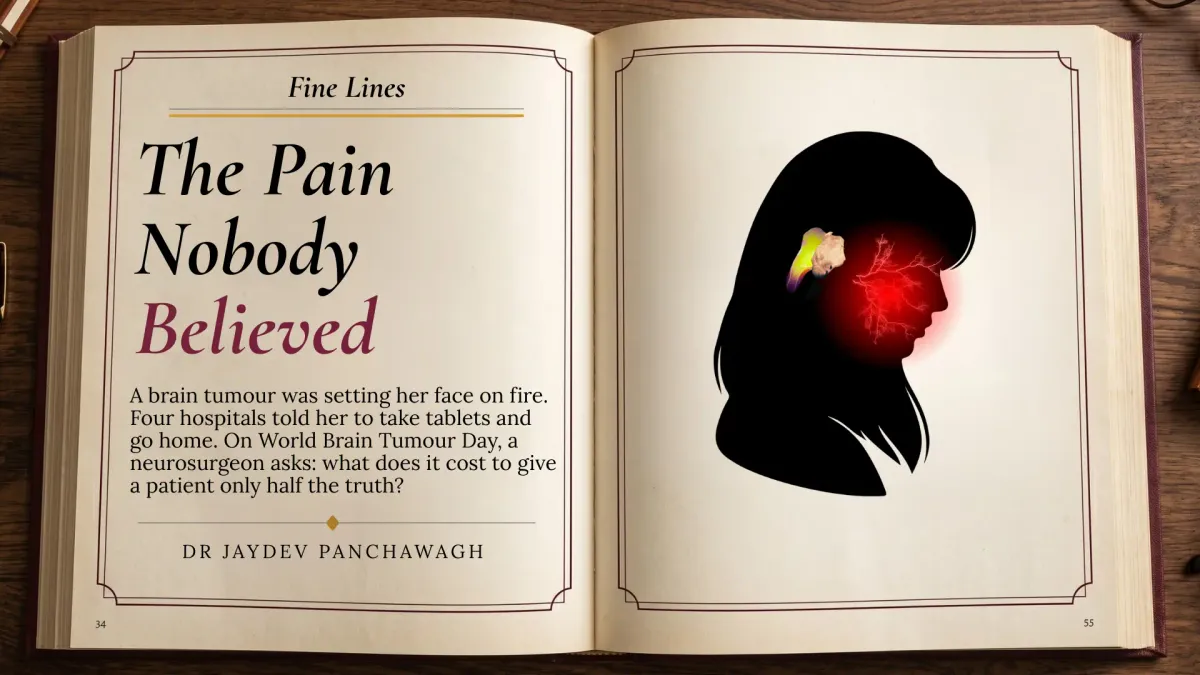
A brain tumour was setting her face on fire. She was in her early twenties, and by the time she came to Pune, pain had made smiling difficult. She had already visited several hospitals. Each consultation had left her with medication, but without an explanation that accounted for the full picture.
She entered the consultation room with her mother, holding herself very still — the careful stillness of someone who has learned that ordinary movement carries a price. Her mother spoke for her. It had been like this for months.
When Pain Becomes the Whole Day
The pain arrived without notice. Even speaking or eating could trigger it.
It had begun as an odd sensation, a warning she could not have known was significant. Then it became electric — triggered by speaking, eating and sometimes by a gust of wind across her cheek. By the time she reached us, smiling had become difficult. Pain had taken an ordinary expression from her face.
Trigeminal neuralgia is a condition involving the trigeminal nerve, which carries sensation from the face through three main branches serving the forehead and eye region, cheek, and jaw. When the nerve is irritated or compressed, it can cause brief, severe episodes of stabbing or electric-shock-like facial pain. The experience can be profoundly disruptive, particularly when everyday activities become triggers.
She had been prescribed carbamazepine, a commonly used first-line medicine for trigeminal neuralgia. Medication can help control symptoms, but it may also cause side effects such as drowsiness, dizziness or difficulty concentrating. In her case, the pain remained a major part of daily life despite treatment.
Pain had erased smiling from her face. That was not a figure of speech. It was what months of uncontrolled facial pain had come to mean in her everyday life.
The Question Behind the Diagnosis
Why was a woman in her early twenties developing this pattern of facial pain?
Trigeminal neuralgia is more commonly diagnosed in later adulthood. When a younger person develops symptoms suggestive of it, clinicians need to consider whether an underlying structural condition could be responsible. The clinical assessment and appropriate imaging, often including MRI, help investigate that possibility.
The important point was not simply to give the pain a name. It was to understand why it was happening. A diagnosis that describes a symptom is not always the end of the investigation; sometimes it is the beginning.
What the MRI Revealed
The scan showed a tumour in the cerebellopontine angle.
The MRI revealed a tumour in the cerebellopontine angle, a region at the base of the skull where the brainstem, cerebellum and several cranial nerves lie close together. Tumours in this area can include meningiomas, schwannomas and epidermoid lesions. Their effects depend on the type, size, position and structures they involve.
In her case, the tumour was pressing on the trigeminal nerve near its root entry zone, where the nerve meets the brainstem. It was also close to other important nerves, including those involved in facial movement and functions of the throat and internal organs. The tumour was benign. But benign does not mean harmless: a slow-growing lesion can still cause significant problems when it occupies a confined space beside critical structures.
Benign does not mean harmless. A slow-growing tumour in a critical location still deserves careful assessment and timely discussion of treatment options.
The concern was that continued growth could increase pressure on nearby structures and make later treatment more complex. The timing and approach to treatment, however, must always be decided from the individual scan, symptoms, tumour characteristics and the patient's overall circumstances.
The Risk of Acting — and Not Acting
A list of surgical risks is only part of an informed decision.
She had been told at other centres that surgery was possible but carried considerable risk. Those concerns were real. The cerebellopontine angle is close to structures responsible for facial movement, hearing, balance and other essential functions. Depending on the tumour and the operation, potential complications can include facial weakness, hearing impairment, cerebrospinal fluid leakage and incomplete symptom relief.
But the conversation had not fully explored the other side of the decision. What might happen if she continued to rely on medication while the tumour remained untreated and potentially enlarged? The risks of observation or delay also need to be explained in the context of the particular tumour. Doing nothing is not automatically a risk-free option.
When she came to us, I discussed the risks of surgery first. Patients deserve to hear them clearly. I also explained that the balance of risks depends on the tumour's anatomy, the experience and focus of the surgical team, available technology, monitoring, and the options for postoperative care. No surgeon can promise an outcome, and no single number can describe risk for every patient.
Risk in surgery is not a fixed number. It must be understood alongside the risks of the alternatives — and the experience and resources available for the procedure.
She had researched her condition. She arrived with her mother, imaging arranged in a folder, and written questions. They were afraid, but they were also thoughtful and prepared. That is exactly how a consultation should work: questions are welcome, and the decision should be shared after the available choices have been explained.
The Operation and the Recovery
The tumour was approached through a retrosigmoid route.
We operated using a retrosigmoid approach, which provides access to the cerebellopontine angle through an opening behind the ear. Under the operating microscope, the tumour was carefully separated from the surrounding structures. The trigeminal nerve was compressed at its root and was progressively released as the tumour was removed.
Facial nerve and auditory pathway monitoring were used during the operation. Intraoperative neurophysiological monitoring provides the surgical team with ongoing information about the function of selected neural pathways. It is an important aid in complex skull-base surgery, used alongside detailed anatomical knowledge and careful microsurgical technique.
The tumour was removed. When she woke, her facial pain had resolved. This was her individual outcome; results and recovery can vary depending on the diagnosis, anatomy and treatment.
The Full Truth Patients Deserve
The information patients need includes the risks of every realistic option.
A brain tumour diagnosis can produce a particular kind of fear. The brain is where we locate memory, identity and the sense of being ourselves. The thought of something growing inside it can make people freeze, delay or accept the first explanation they receive. Seeking another opinion may take courage, time and resources.
She had travelled through months of pain and several consultations before reaching a diagnosis that explained what was happening. She should not have had to work so hard to obtain a complete assessment.
The information we owe patients is not only the name of a surgical risk. It is the full picture: the risks of treatment, the risks of alternatives, what is known and what remains uncertain, and how the team's experience and available technology relate to the proposed procedure. Not every centre is equipped for every complex skull-base operation. Patients should be supported in asking where a procedure is performed regularly and who will be part of their care.
The question is not only whether surgery is possible. It is where it should be done — and by whom.
She came to see me after surgery. She walked in without holding herself still. She sat down without the careful, calculated economy of movement she had carried on arrival. At some point in the conversation, something amused her.
She smiled.
It was an ordinary thing — the kind that happens in rooms everywhere, every day, without anyone marking it. But in this particular corner of medicine, we are sometimes in the business of giving back the ordinary. When it has been taken from someone for long enough, it is never quite ordinary again.
That is what we owe every patient who walks in holding themselves still against the pain. Not just a diagnosis. Not just a list of risks. The full truth — and a clear, considered path towards the life they want to return to.
Names and identifying details have been changed to protect patient privacy. Shared with the patient's consent.
Continue Reading
The Face That Feared the Wind
A patient's journey through facial pain, diagnosis and a discussion of MVD surgery.
Read More →
The Mathematician Who Diagnosed Himself
A story about recognising facial pain and finding an explanation for its cause.
Read More →
The Tumour That Stole His Steps
A reflection on how a brain tumour can affect movement and everyday life.
Read More →


