
A patient walked into my OPD not long ago with a familiar story — pain that could be triggered by a breeze, a bite of food, or the wrong angle of a toothbrush. I began the way I always do: confirming the diagnosis of Trigeminal Neuralgia, then explaining why Microvascular Decompression (MVD), rather than another year of medication, might offer him a path towards lasting relief.
He stopped me before I had finished the sentence.
While waiting outside, he told me, he had already spoken to three other patients in the room. One had undergone the same surgery two weeks earlier and was there only to have the stitches removed. That patient described what the first two weeks had felt like. Another patient also had Trigeminal Neuralgia and was still deciding whether to proceed with surgery. The two of them talked about the same fear. A third patient had Hemifacial Spasm and was there to decide on a surgery date. By the time he sat down in front of me, he had already made up his mind. I had barely finished a sentence.
I have thought about that waiting-room episode often. Nothing I say in a consultation will ever be quite as persuasive as an ordinary conversation between strangers who happen to be sitting in the same room, waiting for the same door to open. What influenced him was not only my explanation of risks and benefits. It was the accumulated, unrehearsed testimony of people who had already walked the road he was considering.
Why Trigeminal Neuralgia Treatment Became a Life’s Focus
A pain with no patience for ordinary explanations
Trigeminal Neuralgia is widely recognised as an exceptionally severe form of facial pain. Attacks may be triggered by something as ordinary as a breeze, a shave, chewing, or the touch of a pillow. More than two decades ago, the severity of this pain became the reason this focused work began. It was not a technique chosen for its elegance, nor a subspecialty selected for its rarity. It began with a patient’s pain and the conviction that, for some patients, it could be addressed with the right assessment and care.
It is worth pausing on why this family of conditions can resist ordinary treatment for so long before a patient reaches a neurosurgeon’s office. In some cases, a pulsating artery lies against a cranial nerve near its exit from the brainstem. Repeated contact may irritate the nerve and contribute to abnormal signalling — pain, facial spasm, or symptoms involving swallowing in response to sensations that should not trigger them. Medication can help many patients manage symptoms, but it does not move a compressing vessel away from a nerve.
This focus soon extended to Hemifacial Spasm and Glossopharyngeal Neuralgia as well. The three conditions look different on the surface, but in selected cases share an underlying neurovascular mechanism: a blood vessel compressing or irritating a cranial nerve. Facial pain, involuntary facial spasm, and pain associated with swallowing can each be disabling in their own way. Each deserves careful diagnosis and an individual discussion of treatment options.
What Twenty-Two Years of Microvascular Decompression Surgery Teaches
Repetition builds a kind of sight
More than 3,000 Microvascular Decompression procedures later, across these conditions, the number itself means little on its own. What matters is what lies behind it. Repetition builds a kind of pattern recognition that cannot be acquired from reading alone. Over the years, a surgeon becomes familiar with the variations that nerves and blood vessels can present. Experience can inform judgement, planning and the ability to recognise anatomy during an operation — while every patient and every procedure still requires individual attention.
The number matters less than what it represents: experience accumulated across many encounters with delicate and variable anatomy.
There is a particular moment, familiar now in a way it was not twenty years ago, when the operating microscope reveals a vessel lying against a nerve root and the anatomy begins to explain the patient’s symptoms. That recognition is not instinct alone. It is informed by prior encounters with similar anatomy, together with careful assessment of the individual case.
Experience is not simply the number of operations performed. It is the judgement, preparation and attention brought to each patient and each procedure.
Medication remains an important part of treatment for many people with Trigeminal Neuralgia. For selected patients in whom neurovascular compression is identified and surgery is appropriate, MVD Surgery may be considered as an option. Whether it is suitable depends on diagnosis, imaging, general health, previous treatment and a discussion of potential benefits and risks.
Why No Neurosurgeon Can Operate Alone
The team behind one pair of hands
Volume alone does not make a centre good, and it has never been the whole story here. High case numbers must be accompanied by genuine attention to patient wellbeing. The same concern that started this work — treating pain that surgery may be able to address — eventually led beyond the operating room, to the founding of a dedicated foundation. Two counsellors work within it specifically for patients living with these conditions, because correcting a nerve surgically does not, by itself, undo months or years of a person having organised life around avoiding pain. That requires conversation, patience and time that a surgical schedule alone cannot provide.
I stand at the centre of a system built, patient by patient, over many years — and I rely on it every time.
None of this is the work of one person. Two assisting neurosurgeon colleagues share the operating table with me for every procedure. An anaesthesia team with long experience in MVD understands the particular demands of this surgery. A postoperative care team recognises the details of recovery, the signs that need attention and the reassurance a frightened patient may need in the early hours after surgery.
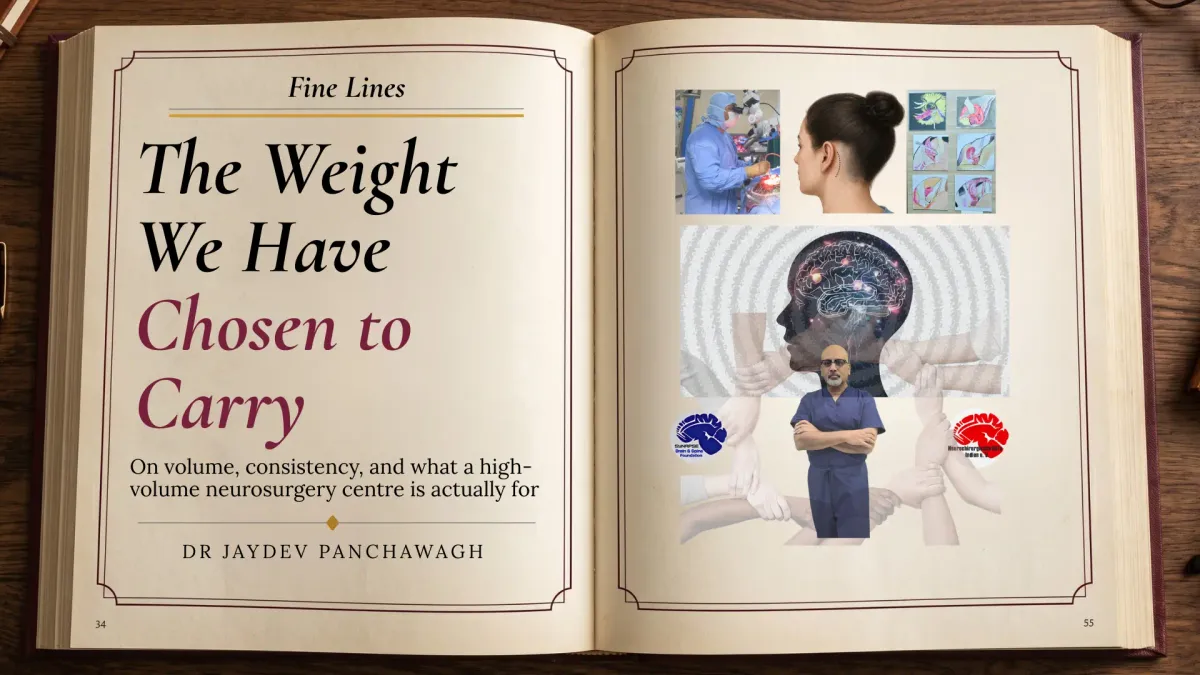
Beyond the hospital, the Synapse Brain and Spine Foundation and our Indo-German partnership, Neurochirurgische Hilfe Indien, form part of the wider structure. And beyond even that, there are the patients themselves — people who once sat where a new patient sits now, and who have formed support groups for those living with Trigeminal Neuralgia, Hemifacial Spasm and Glossopharyngeal Neuralgia. They can offer something no clinician can replicate: the perspective of someone who has actually been there.
There is another layer to this — one that rarely comes up with a patient. It has nothing to do with their nerve or vessel. It has everything to do with whether this surgery will continue to be performed thoughtfully and safely long after I have left the operating theatre for the last time.
Younger neurosurgeons have trained here in this operation, with exposure to a substantial volume of cases. Some of that learning has been written down — not as self-promotion, but because a technique refined through experience is useful only if it can be shared with other surgeons and adapted with care to the patient in front of them.
Measuring MVD Surgery Outcomes Over Two Decades
What consistency actually looks like
There are two different numbers a surgeon can point to. One is how many operations have been performed. The other is how many achieved the intended outcome, and whether that experience has remained consistent as the number of procedures grew. Both matter. But the second gives the first its meaning. Outcomes should be assessed transparently, using clearly defined measures and appropriate follow-up — not inferred from volume alone.
A record built over many years can reflect a team and a set of protocols refined case after case. It should also include honest attention to complications, limitations and the differences between individual patients. A single good year cannot show the same breadth of experience as long-term follow-up, but neither should experience be used as a substitute for discussing a patient's own risks.
Good outcomes, repeated enough times, stop looking like victories and start looking like routine — but every patient deserves the same careful attention.
What this can look like in practice is almost anticlimactic: a patient who arrived flinching at the memory of a breeze on the cheek, recovering after surgery and looking forward to going home. There is no need for drama in that moment. The aim is a carefully planned procedure, appropriate recovery and a return to ordinary activities when the treating team considers it safe.
For a patient travelling from another city, the decision to make that journey involves more than the operation itself. It involves confidence in the assessment, the team, the postoperative plan and the arrangements for follow-up after returning home.
Choosing a Neurosurgeon: Who Are You, and Can This Be Trusted?
The question every patient should ask
The neurovascular project grew from the same place. It did not begin as a plan to expand a practice. It began as a growing feeling that what had been learned over the years deserved a proper home: organised, examined and written down, so it could be shared beyond any one pair of hands. The aim is to contribute to the understanding of these conditions and to help patients make sense of what is being proposed to them.
None of this is offered as a boast. It is offered as an answer to a fair question every patient considering this surgery should ask: who are you, and can this be trusted? A patient can reasonably ask about the surgeon’s experience with the specific procedure, the team involved, how outcomes and complications are monitored, what alternatives exist, what recovery may involve and how follow-up will be arranged.
Experience, a dedicated team and an ongoing commitment to reviewing outcomes can all inform that decision. Technology helps. Technique matters. But what sustains this work, case after case, is attention to the patient and to the outcome — before, during and after surgery.
A number, on its own, proves nothing. What it can do, when it is accurate and placed in context, is help answer one question for a frightened person on the other end of a phone call: can I place my trust in this team? That is the only weight worth carrying into an operating theatre. Not the size of the record, but the responsibility it represents to the next patient — the one still deciding whether the longer journey is worth making.
Names and identifying details have been changed to protect patient privacy. Shared with the patient’s consent.
Continue Reading

The Mathematician Who Diagnosed Himself
A patient's unusual description of facial pain and the importance of recognising patterns.
Read More →
The Face That Feared the Wind
A patient's experience of Trigeminal Neuralgia, treatment decisions and the role of MVD.
Read More →
Inferno on the Face
Understanding severe facial pain and the experience of living with Trigeminal Neuralgia.
Read More →Watch Related Videos
Explore educational videos from Dr. Jaydev Panchawagh on Neurosurgery, Brain and Spine Conditions, and Treatment Options.


