
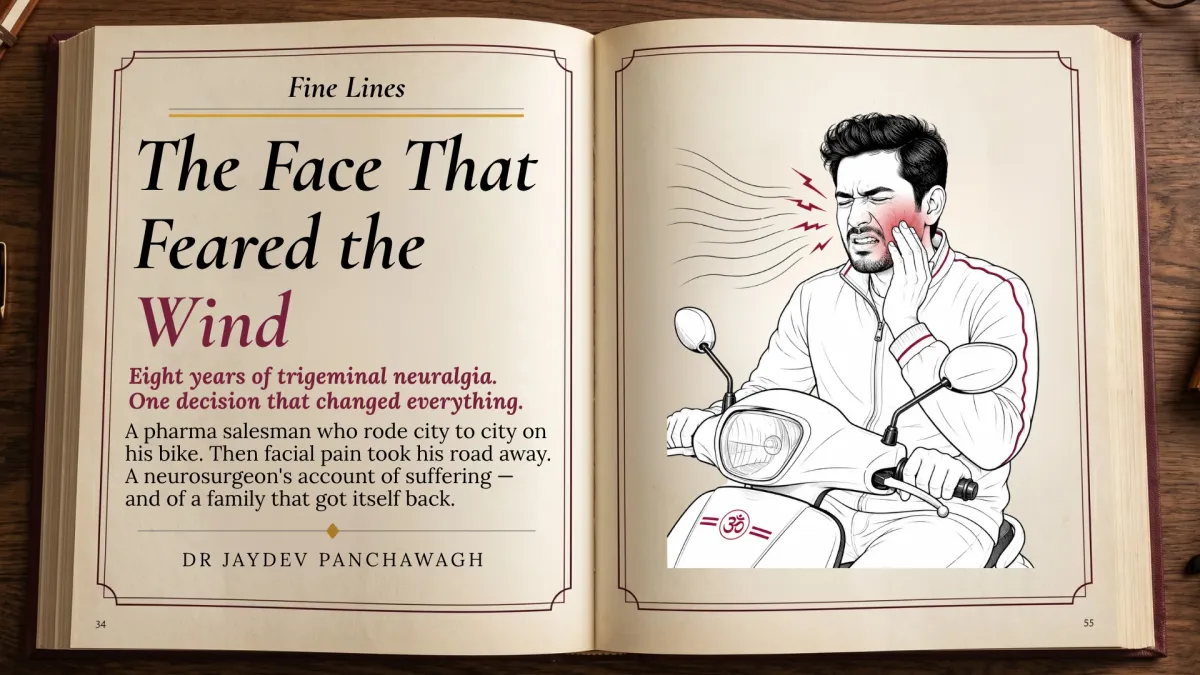
Eight years of trigeminal neuralgia. A photograph on a Tuesday morning. And what MVD surgery may give back that no medication can fully replace: the freedom to return to ordinary moments without constantly anticipating pain.
It is considered one of the most severe pains the human nervous system can produce. The phrase “suicide disease” has sometimes been used to describe the despair that severe, persistent trigeminal neuralgia can cause. I do not reach for that phrase easily. What matters is understanding the seriousness of the condition and the effect it can have on a person's life.
The photograph arrived on a Tuesday morning, between two clinic appointments. A hill somewhere in the background. A man, a woman, a small child. All three of them laughing — the kind of photograph people take without thinking, because they are too busy being happy to think about the camera. His wife had written two lines beneath it: We got our husband and father back.
I set my phone down and sat with that for a moment. In twenty-seven years of neurosurgical practice, I have learned that the measure of surgery is rarely only what happens in the theatre. It is also what happens afterwards, in ordinary photographs like this one.
Mr. Joshi had come to me eight months earlier wearing a scarf. It was May. Pune in May does not ask for scarves.
Eight Years of Living Around Pain
When a breeze, a bite of food or a toothbrush can become a trigger
He was forty years old, a pharmaceutical salesman from Bhopal. His work was the road — two-wheeler, city to city, wind in his face, client to client. Or it had been, once. By the time he sat across from me, he had not completed a full day of field work in years. He had stopped wearing a helmet because the chin strap triggered pain. He avoided morning routes because the air was cooler then, and cooler meant sharper, and sharper meant the thing that happened to his face.
The condition was trigeminal neuralgia. It had begun eight years earlier, when he was thirty-two. A pain in the upper jaw — fleeting, electric, gone before he could describe it. He thought it was a tooth. His dentist thought it was a tooth. One extraction later, the pain was still there and there was one less tooth. He moved through several doctors before someone finally named it correctly.
The trigeminal nerve is the fifth cranial nerve and carries sensation from the face through three main branches: the forehead and eye, the cheek and upper jaw, and the lower jaw and chin. In classical trigeminal neuralgia, a blood vessel may compress the nerve near the point where it enters the brainstem. Repeated contact can contribute to changes in the nerve's insulating covering and abnormal pain signalling.
A sip of cold water. A breeze on the cheek. The touch of a toothbrush. The strap of a helmet. These ordinary acts can trigger a sudden, severe, electric-shock-like pain on one side of the face. The attacks may last seconds, but their unpredictability can shape the rest of the day. Patients often describe not only the pain itself, but also the dread of the next attack.
Mr. Joshi had been prescribed carbamazepine, a commonly used first-line medication for trigeminal neuralgia. It helped partially, for a time. But medication can cause side effects, which may include drowsiness, dizziness or difficulty concentrating. He described feeling as though he was watching life from behind glass.
“I was present, but I wasn't really there.”
That is what Mr. Joshi told me months after his surgery, when he could speak about it clearly. He was still showing up for work, still riding shorter routes with a face covering to shield his cheek from the wind, still doing what needed to be done. But his income had fallen, and his manager had noticed.
Around this time, he got married. His wife had married the man she loved and expected the ordinary things a life together might bring: an evening out, friends over, a family gathering, a trip somewhere. What she found was a husband who flinched when she touched his face, went quiet on some evenings and declined many invitations. Chronic pain, poorly understood by those outside it, can create distance between people who love each other — not through cruelty, but through silence and the slow accumulation of things left unsaid.
Then they had a child. Mr. Joshi told me something he had not been able to tell anyone. He was afraid of his own baby. He loved the child without reservation, but babies reach for your face. They press a small palm against your jaw, grab your cheek, lean their forehead into yours. For someone whose facial pain is triggered by light touch, even an affectionate gesture can become frightening. So he held back. His wife, exhausted and managing much of the care alone, began to carry a weight she could not easily name. Two people who loved each other were living in the same house, yet growing quietly apart.
The Phone Call That Opened a Door
How a friend's recovery from hemifacial spasm encouraged him to seek another opinion
An old friend called one afternoon. This friend had been living with hemifacial spasm — a different condition involving a different cranial nerve, but one that can also be associated with a blood vessel compressing a nerve near the brainstem. He had travelled to Pune for microvascular decompression surgery. His symptoms had improved, and he encouraged Mr. Joshi to seek an assessment.
He told Mr. Joshi: just go once. Just talk to them.
Mr. Joshi was sceptical. Hope, when it has been disappointed enough times, learns to travel quietly. But there was something in his friend's account that was different. It was not a rehearsed testimonial or an extravagant promise. It was the plain account of someone who had been through treatment and wanted another person to understand that an option might exist.
So Mr. Joshi came to Pune with his wife. When a patient walks in with their spouse, it often tells me that the decision is being faced together. We see people at our MVD centre from across India and from abroad for trigeminal neuralgia, glossopharyngeal neuralgia and hemifacial spasm. Each arrives carrying a different history. Before discussing a surgical plan, it is important to understand what the condition has taken from that person's life.
Understanding Microvascular Decompression Surgery
The questions patients ask — and the answers they deserve
We spent nearly two hours with Mr. and Mrs. Joshi. They asked the questions every patient deserves to have answered: Is MVD surgery suitable for me? What does the operation involve? What is recovery like? Can the pain return? How does it compare with other procedures, such as radiosurgery or percutaneous treatments? We discussed the possible benefits, alternatives, risks and uncertainties, including what surgery can and cannot promise.
His MRI showed a blood vessel in contact with the trigeminal nerve near its root entry zone. Imaging findings must always be interpreted alongside the patient's symptoms and examination, but in his case the clinical history and MRI were consistent with classical trigeminal neuralgia associated with neurovascular compression.
Microvascular decompression (MVD) is an operation intended to relieve pressure on a cranial nerve while preserving the nerve itself. It is generally performed through a small opening in the skull behind the ear. Using an operating microscope, the surgeon identifies the relevant nerve and any compressing vessel. Where an offending vessel is confirmed, it is carefully separated from the nerve. A small piece of cushioning material, commonly Teflon, may be placed to maintain separation.
The precise surgical steps depend on the patient's anatomy and the findings during the operation. MVD is major neurosurgery and carries potential risks, which may include hearing changes, facial weakness, cerebrospinal fluid leak, infection, stroke and other complications. The individual risk profile and suitability should be discussed with the treating neurosurgeon.
Unlike procedures that intentionally injure part of the trigeminal nerve to reduce pain signals, MVD aims to address the suspected source of compression without deliberately damaging the nerve. It is not suitable for every patient, and outcomes cannot be guaranteed. For people with an appropriate clinical diagnosis and evidence of neurovascular compression, it may be one treatment option to consider.
They returned to Bhopal that evening. For the first time in a long while, Mr. Joshi left a consultation carrying something other than a revised prescription: a clearer understanding of the condition and the choices available to him.
Is MVD Surgery Right for You?
The conversation that matters most is the one grounded in your own diagnosis
About a month later, Mr. Joshi asked for an online consultation. He had sat with everything we had discussed, considered it with his wife and arrived at the call with a written list of questions. I find these lists valuable. They represent weeks of careful thought — the effort to put fear into words and ask for clear answers.
We talked through every question: the risks, the recovery, what MVD for trigeminal neuralgia may offer and what it cannot promise. In our clinical experience, patients with classical symptoms and imaging that supports neurovascular compression may be considered for this operation. But no general statistic can replace an assessment of an individual's MRI, medical history, overall health and personal priorities.
Patients considering MVD should ask about the surgeon's experience with the procedure, the team's role, expected benefits, potential complications, alternative treatments and the plan for postoperative care and follow-up. It is reasonable to seek another opinion if questions remain unanswered. A decision should be made without pressure and with a clear understanding of both the potential benefits and the risks.
At the end of that consultation, Mr. Joshi told me he wanted to proceed. The decision was his and his wife's, made after time to consider the information and discuss their concerns.
Three Months After MVD Surgery
What it means when a scarf becomes just a scarf
It has now been three months since the operation. At his follow-up, Mr. Joshi reported that he was pain-free and had stopped taking his trigeminal neuralgia medication under the treating team's guidance. The drowsiness he had experienced while taking medication had lifted. He was gradually returning to longer driving routes for work. The scarf was still in his bag — not because he needed it, he told me, but out of habit. Then he laughed a little at himself for saying it.
And then, on a Tuesday morning, the photograph. A hill in the background. All three of them laughing. His wife had written two lines beneath it: We went on our first family trip last week. I have my husband back, and my child has his father.
I have operated on trigeminal neuralgia many times. The surgery itself can be described with precision — the approach, the view of the nerve, the moment a compressing vessel is separated. What is harder to describe is what that photograph contains: the routes he had stopped riding, the child he was afraid to hold, the evenings his wife spent alone in a house he was also in — and the possibility of those ordinary moments returning.
Every patient's outcome is different. MVD can provide meaningful relief for appropriately selected patients, but it does not guarantee that pain will disappear or never return. Recovery and medication changes must be guided by the treating team.
For Mr. Joshi, the change described at follow-up was profound. The aim of treatment is not simply to address a nerve or an MRI finding. It is to help a person regain as much of their everyday life as possible, while being honest about what treatment can and cannot achieve.
There are people reading this who are living some version of Mr. Joshi's story: the face that flinches at the wind, the marriage growing quietly strange, the distance from a child they love completely but are afraid to hold. If this feels familiar, consider seeking an assessment from a clinician experienced in facial pain and cranial nerve conditions. Understanding the cause is the first step towards discussing appropriate options.
That is the only reason I write these essays.
Names and identifying details have been changed to protect patient privacy. Shared with the patient's consent.
Continue Reading

The Mathematician Who Diagnosed Himself
A patient's unusual description of facial pain and the importance of recognising patterns in trigeminal neuralgia.
Read More →
The Pain Nobody Believed
A patient's experience of persistent facial pain, the search for a diagnosis and the impact on daily life.
Read More →
The Stranger in the Photographs
A changing face, a pituitary tumour and the importance of recognising gradual symptoms.
Read More →


