

I operated on DKM in February 2020. When he sat across from me again this July — over six years later — I noticed something I see in most operated patients. Confidence in body movements, knowing that a pain attack is not around the corner.
His face was calm. It had always been calm. Even back when he was describing his pain to me for the first time, before surgery. What has changed is everything underneath that calm. Before surgery, that stillness was braced. Waiting for pain to come any moment. A person living with Trigeminal Neuralgia learns to carry a kind of low-grade anticipation everywhere — will the fan turn on, will someone brush past my face, will I need to brush my teeth soon. Will the pain come when I chew or open my mouth? What if I have to talk?
That tension doesn’t always show up in what a patient says. It shows up in how they hold themselves. This July, that tension simply wasn’t there. He sat the way a person sits when their body has genuinely stopped expecting pain. I’ve learned to watch for that shift over the years, and it’s one of the more honest signs of a good outcome — more honest, sometimes, than what patients say out loud.
He’s been back to see me twice since his surgery. Not for follow-up in the clinical sense — just to say hello. Both times, he’s asked to sit in on my OPD for a while and talk to patients who are currently living with Trigeminal Neuralgia, sharing what it was like for him, before and after. He offers to do this as his social responsibility of spreading awareness and supporting diagnosed patients.
Diagnosing Trigeminal Neuralgia: A Patient Who Noticed What Doctors Missed
Recognising the pattern behind brief, electric-shock-like facial pain — and the importance of listening carefully to what patients describe.
DKM is a professor of mathematics at a prestigious university in North India. I think that detail matters, because of how precisely he arrived at his own diagnosis — well before any doctor was willing to commit to it.
He arrived, having filtered it correctly.
It began with a strange, brief electric flash across his forehead while drying himself with a towel after a bath. Most people would let a sensation like that pass. He noticed it, dismissed it once, and then paid close attention when it happened again in exactly the same way, doing exactly the same thing. Most doctors who are otherwise familiar with this disease may tend to overlook an occasional, brief, electric-shock-like pain — because it’s occasional, because it passes quickly, because on its own it doesn’t look alarming. What an intelligent, observant patient notices, and what a medical consultation may often miss, is that this pain is different in character from ordinary pain, and that it’s unusual precisely because it follows specific, repeatable triggers. A towel on the forehead. Cold water. A breeze. That pattern is the disease announcing itself, long before it becomes impossible to ignore.
DKM saw three doctors before anyone would use the words Trigeminal Neuralgia. He’d already found the term himself by then, matched his own symptoms against the clinical description, and was, in effect, waiting for a doctor to catch up to a conclusion he’d already reasoned his way to. That’s not something I see often. Most patients arrive overwhelmed by conflicting information. He arrived, having filtered it correctly.
Recognising the characteristic pattern of facial pain is an important part of assessment. You can read more about the condition, its symptoms and diagnostic approach on our Trigeminal Neuralgia Information Page.
Living With Trigeminal Neuralgia: Four Years Before Surgery
Four years of adapting daily routines around unpredictable pain — and the physical and emotional burden that can accompany the condition.
The four years between his first symptom and his surgery tell you more about this disease than any textbook does.
Like standing beside someone welding — except the electrode was inside his own head.
He kept teaching through all of it. In his city, winters are harsh — temperatures can fall to two or three degrees Celsius — and cold is one of the more reliable triggers for this kind of pain, which is why winter tends to be the hardest season for almost every Trigeminal Neuralgia patient I treat, not just him. He wore two caps and wrapped a wool band across his forehead to get through those months. He bathed every day knowing, with total certainty, that the moment water touched his forehead, the pain was coming. He did it anyway, because there wasn’t another option. His oxcarbazepine daily dose climbed from 200mg to 1,200mg over the course of a year as the disease progressed, controlling the pain somewhat, but leaving him with a constant dull heaviness that never fully lifted.
He described the pain itself in a way that still gives me goosebumps: like standing beside someone welding — the electrode sparking against metal — except the electrode was inside his own head. Three to five seconds of it, he told me, but so intense that anything longer would be unsurvivable.
Trigeminal Neuralgia can affect ordinary activities such as eating, speaking, washing the face and brushing teeth. Understanding these symptoms can help patients explain their experience during a consultation. More information is available on our Trigeminal Neuralgia Page.
What Trigeminal Neuralgia Patients Teach Me That No Textbook Can
Clinical knowledge explains the mechanism of pain. Listening to patients helps a surgeon understand what living with it actually feels like.
My training in neurosurgery, and MVD surgery, taught me the pathophysiology of Trigeminal Neuralgia — the symptoms, the vascular compression, the pain pathways, the mechanism behind why decompression works. It didn’t give me the felt experience of it. That only comes from patients, and only from the ones who can put it into words.
DKM’s welding analogy is one I still reach for, years later, when I’m explaining this disease to a newly diagnosed patient, or to a relative who cannot comprehend how the pain can be so unbearable. No textbook gave me that image. He did. He isn’t the only patient who’s taught me something this way — over the years, a handful of people, usually natural observers of themselves for one reason or another, have described this pain precisely enough that I’ve genuinely learned from them. Not the diagnosis, nor the treatment. But the texture of the thing itself — how a ten-second event can come to dominate a person’s entire relationship with their own face, their own morning routine, their own sense of safety in the most ordinary moments.
A mathematician’s mind, trained to observe precisely and report exactly what it observes, turns out to be unusually well suited to this. DKM didn’t just tell me he was in pain. He told me what kind, how it began, how it traveled, how long it lasted, and how its total absence for twenty-two strange months in 2018 and 2019 felt different from its presence before and after. That kind of self-observation is rare. Dedicating my career to the surgical treatment of Trigeminal Neuralgia and Hemifacial Spasm has made me a better listener with every patient — including the ones who struggle to find any words at all for what they’re feeling. I ask better questions now, because I know what a complete answer can sound like.
Trigeminal Neuralgia Surgery: A Mathematician's Approach to Risk
Understanding the decision for surgery, weighing treatment options and the principle behind Microvascular Decompression.
By the time DKM came to me, he’d already done more independent research into Microvascular Decompression than most referring physicians ever do. He’d read the surgical literature, watched procedure footage from our MVD centre in Pune and centres abroad, and understood the alternative treatments well enough to explain to me, unprompted, why he’d ruled them out — the other surgical options for Trigeminal Neuralgia carry a meaningful chance of the pain returning within a few months to a year or two, while MVD offered something closer to a lasting answer.
An artery moved a few millimetres, and held there.
What I remember most, though, is how he framed the decision. He didn’t ask me whether surgery was safe. He understood, correctly, that no surgery is without risk. He asked me to help him weigh which side carried more risk — operating, or continuing the life he was already living. He put it in terms of probability, the way you’d expect a mathematician to. He concluded that the risk of something going wrong in surgery was small, and the near-certainty of his quality of life continuing to erode without it was the far larger risk. Once he’d reasoned it through that way, he told me, the fear simply left. Not even on the operating table did it return.
I’ve had this conversation, in some form, with hundreds of patients. I don’t think I’ve had it with anyone who arrived at it quite this rationally.
The surgery itself is called Microvascular Decompression. Under the microscope, the cause becomes visible almost immediately — an artery, pulsing, resting directly against the trigeminal nerve. Every heartbeat, that pulse strikes the nerve. Over years, that repeated contact is what generates the pain. We lift the artery away from the nerve. We keep it separated with a small piece of teflon, placed between the two so the artery can no longer touch the nerve. The compression is gone. There is nothing more dramatic to it than that — an artery moved a few millimetres, and held there.
You can learn more about the procedure, its purpose and the surgical approach on the Microvascular Decompression Surgery Page.
He woke up. The first thing he checked for was the pain. It wasn’t there. It still isn’t.
Life After Trigeminal Neuralgia Surgery: Six Years On
A six-year perspective on life after surgery — and one patient's decision to support others facing the same diagnosis.
What stays with me isn’t the clinical outcome on its own — I expect a good outcome from a well-selected MVD case, and his was one. It’s watching a person who spent four years building his entire day around avoiding triggers now sit in front of me with no tension left in his body. And it’s the fact that, twice now, he’s chosen to spend part of a visit to Pune sitting in my OPD, talking with patients who are exactly where he once was — not because I asked him to, but because he wanted to. He’s spoken about all this on camera too, in his own words, for anyone who would rather hear it from him directly than read it from me — his full interview is on our YouTube channel, linked at the end of this piece.
A man who spent four years organising his whole day around avoiding pain now spends part of his day helping a stranger get through the wait.
What stays with me is simpler than any of it: a man who spent four years organising his whole day around avoiding pain now spends part of his day helping a stranger get through the wait.
Every patient's recovery and experience is individual. For people exploring surgical treatment, understanding the procedure and discussing their own circumstances with a neurosurgeon are important steps. You can read more about MVD Surgery and Dr. Jaydev's Neurosurgical Practice.
Trigeminal Neuralgia Awareness: Why I Keep Telling This Story
Recognising the condition earlier begins with awareness, careful listening and taking unusual facial pain seriously.
Trigeminal Neuralgia is still poorly recognised, even within medicine. DKM saw three doctors before one would say the words out loud. If a research-minded mathematician, capable of diagnosing himself with real precision, still spent years being told he didn’t have what he clearly had, it’s worth asking how many people without his persistence are living with this pain right now, unnamed.
If any part of what he described sounds familiar — a flash of current, brought on by touch, cold, or a breeze, lasting only seconds but unbearable while it lasts — it has a name. Trigeminal Neuralgia.
Learning about the condition is a useful first step. If you are experiencing facial pain or symptoms that concern you, seek an assessment from an appropriately qualified medical professional. You can explore our Trigeminal Neuralgia Resource or contact the clinic to enquire about an appointment.
Watch DKM’s full interview, in his own words:
Continue Reading
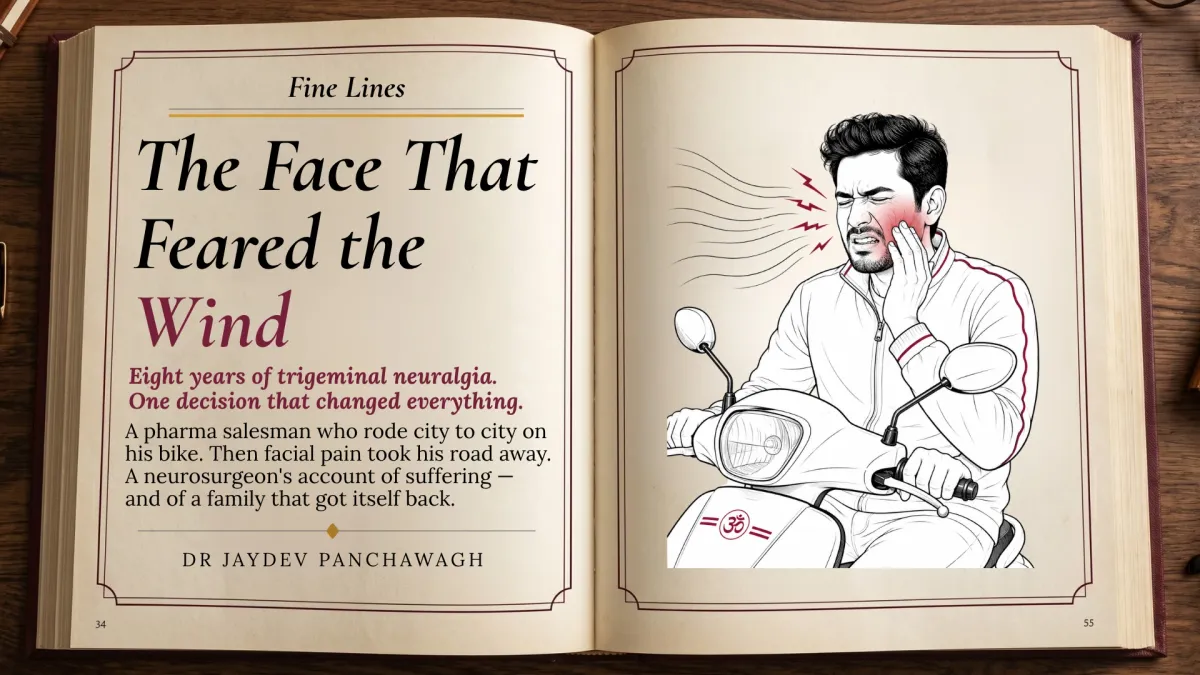
The Face That Feared The Wind
Explore the experience of facial pain triggered by everyday sensations and the challenges of living with Trigeminal Neuralgia.
Read More →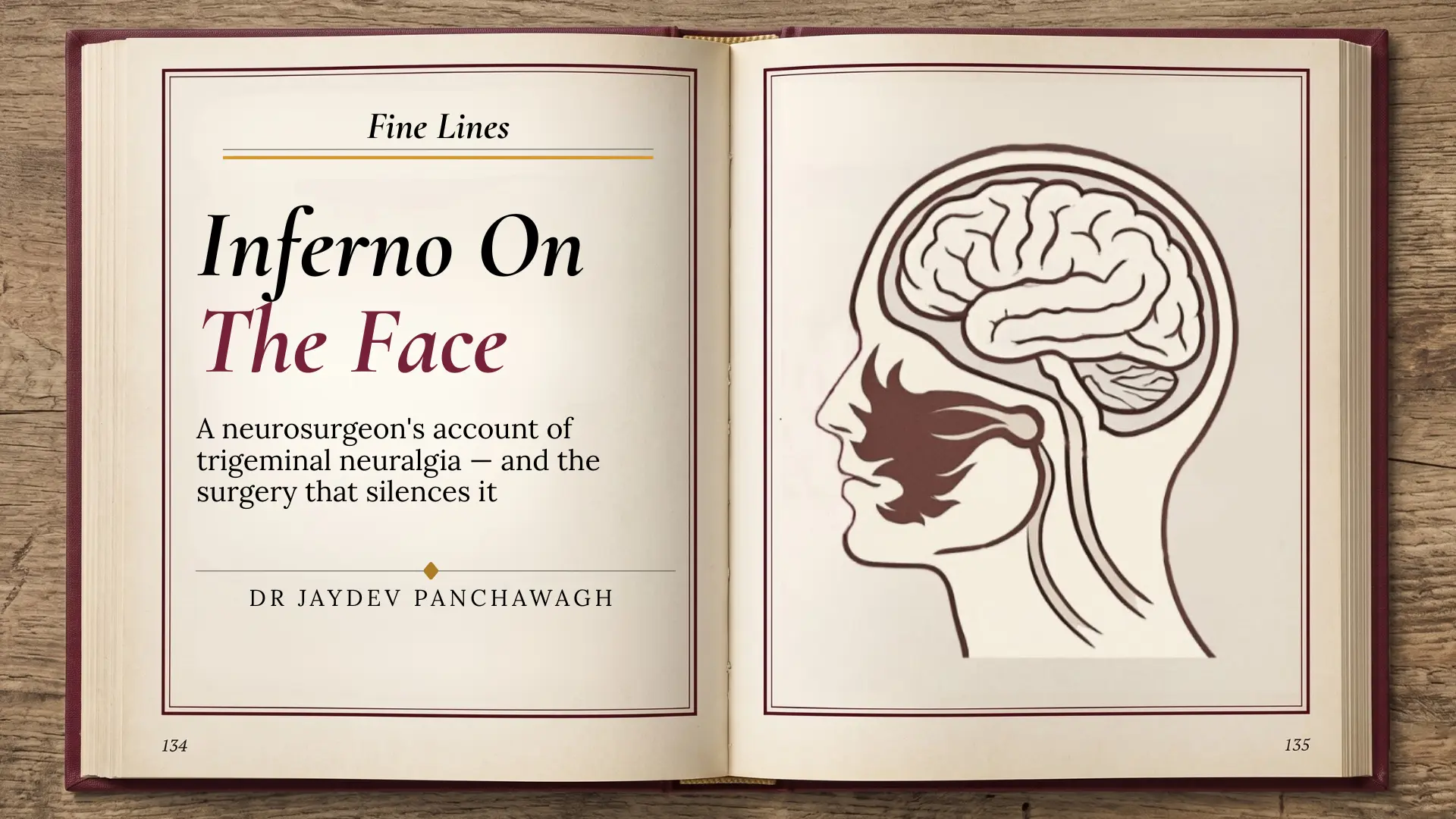
Inferno On The Face
A closer look at the intensity of facial nerve pain and the impact it can have on everyday life.
Read More →
The Eye That Winked Without Permission
Understand Hemifacial Spasm, involuntary facial movements and the role of specialist assessment.
Read More →Watch DKM's Patient Interview And Related Videos
Hear patient experiences and explore educational videos from Dr. Jaydev Panchawagh about Trigeminal Neuralgia, treatment options and neurosurgical care.


