
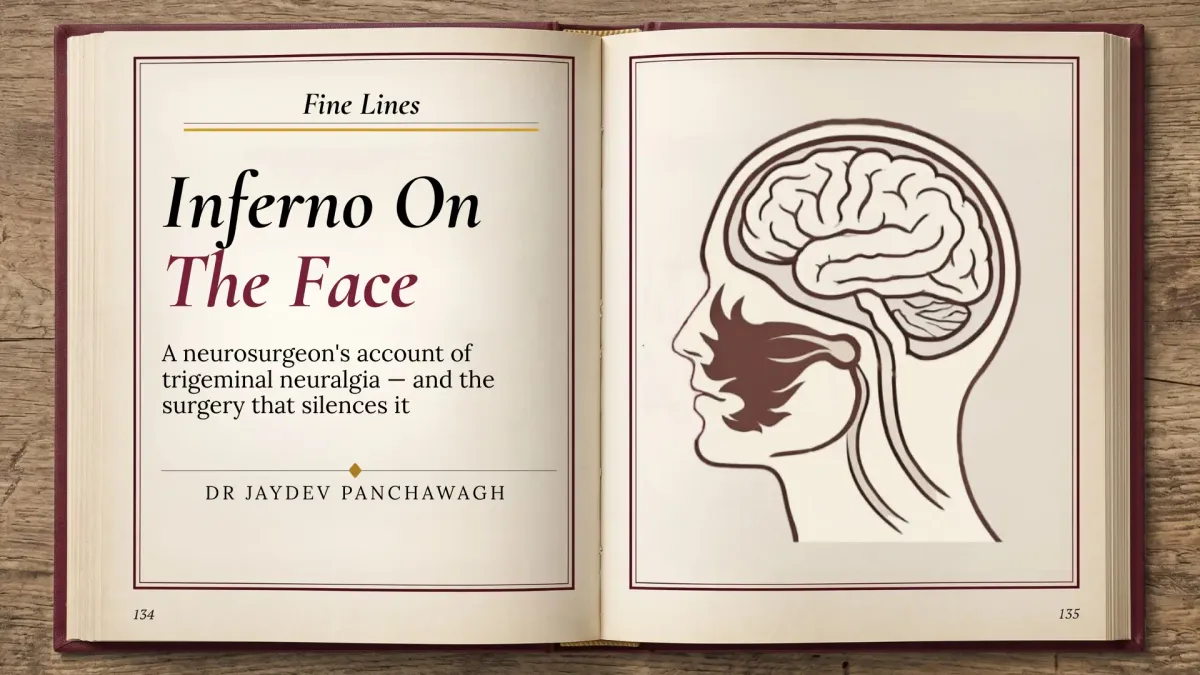
Many people with trigeminal neuralgia spend months or years searching for an explanation for severe facial pain. Nivedita Bhatnagar, whose name has been changed, was an architect from Delhi. By the time she reached our centre, even speaking could trigger a sudden electric-shock-like pain across the right side of her face.
Her experience raises an important question: when facial pain persists despite treatment, are we looking carefully enough for the cause — and are patients being given a clear understanding of the options available to them?
Nivedita: An Architect Without Words
When the simple act of speaking becomes a trigger for pain
Nivedita was an architect from Delhi — capable, perceptive and accustomed to expressing herself clearly. Yet when she first came to our centre, she could manage little more than gestures. Opening her mouth to form words could trigger a bolt of pain across the right side of her face. The ordinary architecture of language had become a minefield.
“It truly began in January 2004. A sudden, sharp pain would start in the upper right gum and radiate into the right cheek. The pain was like an electric shock. Instant. Without warning. Brushing my teeth, if the brush touched the right gum — or while chewing on that side — these were enough to trigger it.”
Like many people with pain in the teeth or jaw, she first consulted a dentist. A root canal was performed on an upper right molar, but the pain persisted and became more disruptive. A neurologist later recognised a possible nerve-related condition and prescribed carbamazepine.
“The medicine helped while it worked. But it made me drowsy. I began forgetting things. As the dose increased, I started losing my balance when I walked. I thought: if one nerve in one small location is the problem, why am I numbing every nerve in my body? That is not treatment. That is suppression.”
Her frustration was understandable. Medicines such as carbamazepine are commonly used to control trigeminal neuralgia pain, but they do not correct a structural compression when one is present. They can also cause side effects, including drowsiness, dizziness and difficulties with concentration. The right treatment plan depends on the diagnosis, response to medication and the patient's individual circumstances.
The Architecture of Fear
The anticipation of an attack can reshape the ordinary routines of life
It is not only the pain itself that can dominate a patient's life. It is also the anticipation of pain. Between attacks, the person may wonder whether the next jolt will arrive while eating, speaking, brushing their teeth or stepping outside into cold air.
Some people begin avoiding particular foods, shortening conversations or withdrawing from social activities. The face — the part of us through which we speak, eat and express emotion — can begin to feel like a danger zone.
Persistent pain can affect sleep, attention, mood and the way a person responds to possible threats. The burden is therefore not limited to a single nerve or a brief episode. It can influence daily habits, relationships and confidence. Patients deserve to have these effects taken seriously as part of their care.
What Is Trigeminal Neuralgia?
Understanding the nerve that carries sensation from the face
The trigeminal nerve is the fifth cranial nerve and the major sensory nerve of the face. It has three main divisions: the ophthalmic branch, serving the forehead and eye region; the maxillary branch, serving the cheek and upper jaw; and the mandibular branch, serving the lower jaw.
Trigeminal neuralgia causes recurrent episodes of severe facial pain, often described as stabbing, shooting or electric-shock-like. Attacks may be triggered by light touch, chewing, brushing the teeth, talking or a breeze across the face.
In some patients, imaging and clinical assessment identify a blood vessel pressing on the trigeminal nerve near the point where it enters the pons, a part of the brainstem. This area is known as the root entry zone. Repeated vascular contact and pulsation may contribute to changes in the nerve's protective myelin covering and abnormal signalling.
The superior cerebellar artery is a common vessel involved in neurovascular compression, though the anatomy varies between patients. MRI, interpreted alongside the clinical history and examination, can help assess whether a structural cause is present.
“The nerve is not necessarily the original problem. In some patients, it is being irritated by a neighbouring blood vessel — and identifying that distinction can change the treatment discussion.”
Treating the Cause, Not Only the Signal
Why treatment choices depend on the mechanism behind the pain
Medication is often the first step in managing trigeminal neuralgia. For many patients it provides meaningful relief. When pain remains uncontrolled, side effects become difficult to tolerate, or the clinical picture suggests a structural cause, further evaluation and a discussion of procedural or surgical options may be appropriate.
Procedures such as radiofrequency treatment, glycerol rhizolysis, balloon compression and stereotactic radiosurgery work in different ways, but they generally aim to modify the pain signals carried by the trigeminal nerve. They may be appropriate options for selected patients. Each has its own potential benefits, limitations and risks, including the possibility of facial numbness.
Microvascular decompression is different. It is considered when a blood vessel is compressing the trigeminal nerve and the patient is an appropriate candidate. Rather than intentionally injuring the nerve, the operation aims to separate the vessel from it. The suitability of any treatment must be assessed individually; no procedure is right for every patient.
Peter Jannetta and Microvascular Decompression
A surgical idea built around relieving pressure while preserving the nerve
In the 1960s, American neurosurgeon Peter Jannetta helped establish the modern role of microvascular decompression for trigeminal neuralgia. The underlying principle is direct: when an offending blood vessel is compressing the nerve, carefully move the vessel away and maintain separation between the two structures.
Through a small opening in the skull behind the ear, the surgeon reaches the trigeminal nerve in the posterior fossa using an operating microscope. If a responsible vessel is identified, it is gently mobilised away from the nerve. A small piece of cushioning material, commonly Teflon felt, may be placed to keep the structures apart.
The aim is to relieve the compression while leaving the trigeminal nerve anatomically intact. Published studies report substantial rates of pain relief after MVD in appropriately selected patients, although results vary with patient selection, pain characteristics, follow-up period and surgical factors. MVD is major surgery and carries risks that should be discussed in detail.
“After surgery, the pain was gone. Completely gone. The fear was gone. The medications were stopped. I had forgotten what it was like to simply eat a meal, or speak freely, or feel wind on my face.”
Nivedita also reflected on the years she had spent living with the condition before reaching a treatment that addressed the compression identified in her case. Her experience is one patient's account, not a guarantee of what another person will experience.
The Gap That Must Be Closed
Connecting patients with accurate information and timely assessment
The delay in diagnosis can have many causes. Facial pain may initially resemble a dental problem. Patients may not know that trigeminal neuralgia is a recognised neurological condition, and not every clinician encounters it frequently. Clear information and appropriate referral pathways can make a meaningful difference.
A general practitioner who recognises the characteristic pattern and arranges referral, a neurologist who explains the available options, and a family member who helps the patient find an experienced team can each play an important role.
If someone experiences repeated, severe, electric-shock-like pain on one side of the face — especially when triggered by touch, chewing, brushing or speaking — they should seek medical assessment. Dental causes and other conditions may need to be considered before a diagnosis is made. A clinician can determine whether neurological evaluation and MRI are appropriate.
A Note on This Writing — Gudi Padwa
A day of beginnings, renewal and resolve
I first wrote about this on Gudi Padwa — the Marathi New Year, a day associated with beginnings and renewed resolve. The gudi, a decorated staff raised as a banner of victory, is a symbol of rising above adversity. Peter Jannetta's contribution to the operating room represents, in its own way, a similar determination to rethink what was possible for patients living with severe facial pain.
If someone you know lives with lightning-like pain on one side of the face — pain triggered by the lightest touch, food, cold air or the simple act of speaking — encourage them to seek a proper assessment. There may be an identifiable cause, and several treatment approaches may be considered depending on the findings.
The face need not remain an unexplained source of suffering. The first step is recognising the pattern and finding the right medical guidance.
The author is a neurosurgeon based in Pune, with a specialised focus on Microvascular Decompression for trigeminal neuralgia and hemifacial spasm since 2004.
Continue Reading
The Face That Feared the Wind
A patient's journey through facial pain, diagnosis and a discussion of MVD surgery.
Read More →
The Mathematician Who Diagnosed Himself
A story about recognising facial pain and finding an explanation for its cause.
Read More →
The Tumour That Stole His Steps
A reflection on how a brain tumour can affect movement and everyday life.
Read More →


