
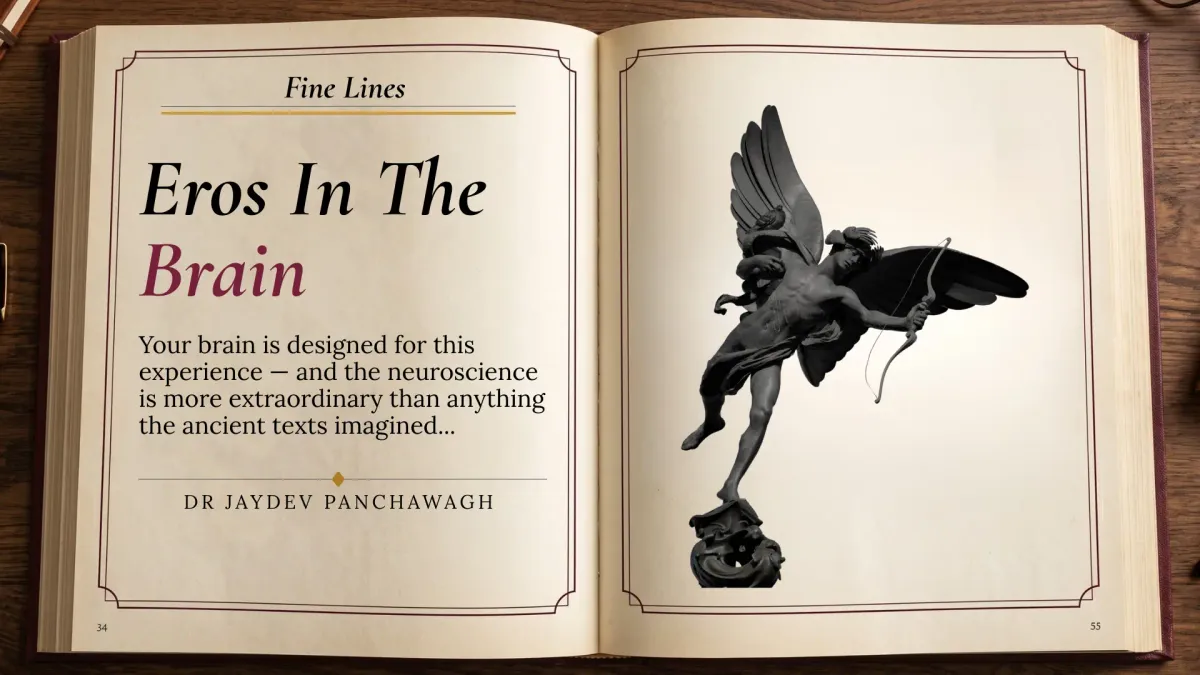
There is one experience we have not yet considered in our journey through the brain. It is, in some ways, among the most fundamental of human experiences — celebrated, questioned, theorised about and represented in poetry, art and sacred texts. I am speaking of sexuality, and of what modern science studies as the neurobiology of sexual experience.
Your brain is not a passive observer of intimacy. It coordinates sensation, attention, emotion, motivation and bodily response through networks that work together. Understanding those processes does not diminish the human experience; it gives us another way to appreciate its complexity.
A Subject We Have Never Stopped Thinking About
From ancient treatises to the scanning room.
For much of recorded history, sexuality has been shaped by a complicated mixture of cultural norms, religious interpretation, social power and personal belief. In many settings it was surrounded by silence or shame; in others it was treated as a subject worthy of intellectual and aesthetic inquiry.
Ancient Indian literature offers one example of a more expansive conversation. References to desire and relationships appear across a range of texts. Vatsyayana’s Kamasutra, generally dated to the early centuries of the Common Era, is often reduced in popular imagination to a catalogue of techniques. It is broader than that: a treatise concerned with relationships, conduct, social life and the place of desire within human experience.
In the modern period, researchers such as Havelock Ellis, Alfred Kinsey, and William Masters and Virginia Johnson helped bring sexuality into systematic study. Their work examined behaviour and bodily responses. Later developments in brain imaging and neuroscience made it possible to investigate some of the neural processes associated with arousal and intimacy.
What changes when an experience once discussed mainly through culture and philosophy is also examined through the living brain?
What Happens in the Brain During Arousal
Attention, emotion and the body's response work together.
Masters and Johnson described a sequence of phases in the human sexual response: excitement, plateau, orgasm and resolution. These remain a useful historical framework, although individual experiences do not always follow a fixed sequence. Contemporary research suggests that sexual arousal involves distributed networks rather than a single brain centre switching on or off.
Brain-imaging studies have reported changes in activity across regions involved in attention, motivation, reward, sensory processing and emotional regulation. Some studies have observed reduced activity in parts of the prefrontal cortex during aspects of sexual arousal. These regions contribute to planning, self-monitoring and evaluating context. Their activity varies with the person, the task and the conditions of the study.
It would be too simple to say that the brain's moral system switches off or that a single neural change explains sexual experience. Freud's idea of the superego is a psychological concept, not a direct anatomical structure. Neuroscience can study related processes such as inhibition, attention and self-monitoring, but it does not map one-to-one onto that older model.
The amygdala, safety and emotional context
The amygdala is part of a broader network involved in detecting emotionally significant information, including potential threat. Research into sexual arousal has found changes in activity in the amygdala and connected regions, but findings are not uniform. A person's sense of safety, stress, relationship context and individual history can all influence the experience.
Shame, anxiety, trauma and fear can affect desire and sexual function. That does not mean a brain scan can diagnose the cause of an individual's difficulty. Sexual concerns are best understood in context, with attention to physical health, medication, emotional well-being, relationships and personal circumstances.
At the Moment of Orgasm
A coordinated pattern of sensation, reward and autonomic response.
Orgasm is associated with coordinated activity across brain systems involved in sensation, movement, reward, emotion and autonomic regulation. It is not simply one centre activating. Multiple networks contribute to the subjective experience, and the pattern can vary between individuals and across circumstances.
Dopamine is involved in motivation, learning and reward. Endogenous opioid systems also contribute to pleasure and pain modulation. During sexual activity, these and other chemical messengers may participate in the changing experience of anticipation, arousal, climax and relaxation.
The experience is not reducible to a chemical formula. Neurochemistry helps explain parts of it, while the meaning remains deeply personal.
Some research suggests that sexual activity and orgasm can temporarily influence pain perception in certain people. The effect is variable and should not be treated as a therapy for chronic pain or as a substitute for assessment and treatment of a pain condition.
The Bonding Aftermath
Oxytocin, prolactin and the many dimensions of closeness.
Oxytocin and prolactin are among the hormones studied in relation to sexual response and the period after orgasm. Oxytocin is involved in several social and reproductive processes, including childbirth and breastfeeding, and has also been investigated for its role in social bonding and trust. Prolactin levels may change after orgasm and are associated with aspects of sexual satiety.
It is tempting to call these simply “bonding hormones,” but human attachment is more complicated than the action of any one chemical. Relationships are shaped by memory, trust, communication, safety, culture and shared experience. Hormones participate in that biology; they do not dictate whom a person loves or guarantee attachment.
What is remarkable is the way the brain and body coordinate physical response with emotional and social processes. The biology provides possibilities. Human relationships give those possibilities their individual meaning.
Beyond the Biological
Peak experiences, attention and the sense of connection.
Human beings seek experiences of joy, absorption, connection and fulfilment in many places: music, art, sport, nature, meditation and relationships. Some of the neural systems involved in reward, attention and emotion overlap across these experiences. That does not make them identical, but it reminds us that the brain uses interconnected networks to support many forms of meaningful engagement.
Sexual well-being can be influenced by stress, health conditions, medication, fatigue, relationship dynamics and beliefs about the body. A rigid or shame-based environment may make it harder for some people to feel safe and present. But no single psychological explanation applies to everyone, and sexual difficulties should not be reduced to a failure to relax or to a particular belief system.
When concerns persist or cause distress, a confidential conversation with an appropriately qualified healthcare professional can help identify physical, psychological or relationship factors and discuss suitable support.
The Wisdom of Vatsyayana
A reminder that human experience deserves thoughtful attention.
The enduring contribution of texts such as the Kamasutra is not that they anticipated modern neuroscience. They belong to a different intellectual tradition, with its own language, questions and social context. Their significance lies partly in treating desire and relationships as subjects that could be examined, discussed and situated within a wider account of human life.
Neuroscience approaches the subject with different tools. It can describe patterns of neural activity, hormonal signalling and bodily response. It cannot, by itself, settle questions of ethics, intimacy, meaning or the value a person gives to an experience.
Perhaps the most useful meeting point between the older traditions and contemporary science is a simple one: sexuality is a part of human life that deserves knowledge rather than misinformation, care rather than shame, and respect for the dignity and consent of every person involved.
To understand the brain is not to diminish human experience. It is to appreciate how much is happening beneath the surface.
Continue Reading
The Body Speaks First
Reflections on the relationship between the brain, body, movement and mind.
Read More →
The Weight We Have Chosen to Carry
A reflection on volume, experience and the responsibilities of a surgical team.
Read More →
The Mathematician Who Diagnosed Himself
A reflection on the brain, symptoms and the importance of understanding what the body communicates.
Read More →Understanding the brain helps us understand human experience.
If you are experiencing persistent facial pain or have questions about a diagnosis, arrange a consultation to discuss appropriate assessment and treatment options.


