The Bangles Would Not Pass Her Knuckles
Sara had worn them since her wedding — thin gold, six on each wrist. One morning they stopped at the base of her hand. She pushed. They held. She told herself she had eaten too much salt.
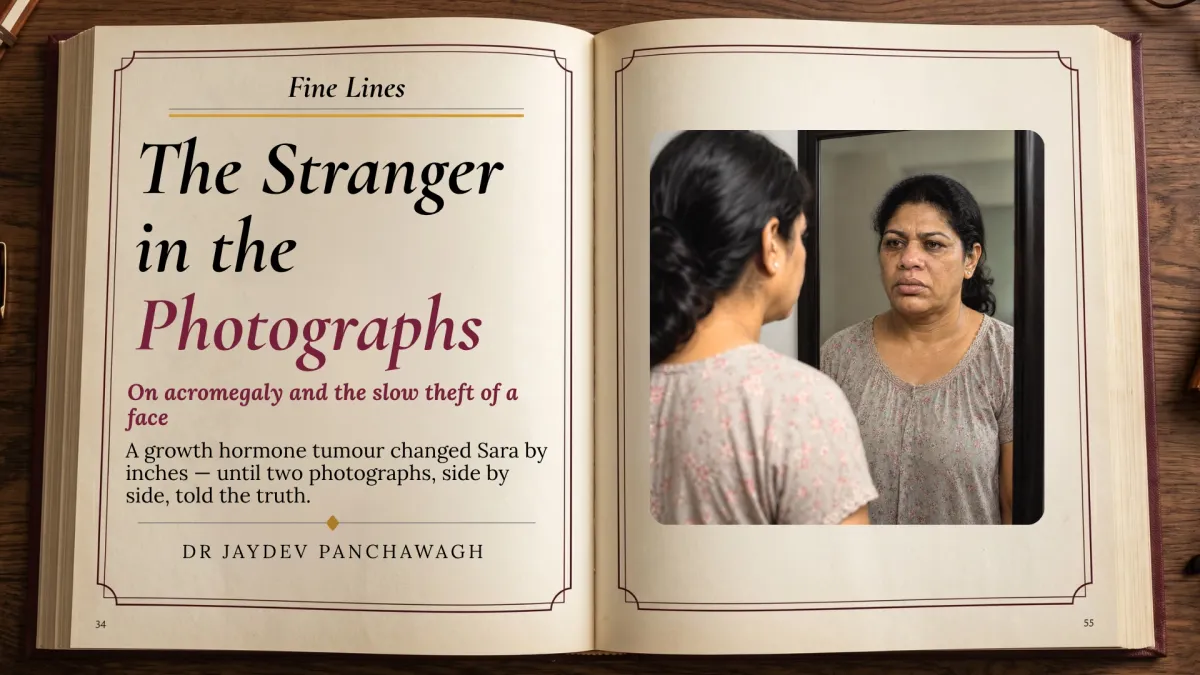
She was thirty-eight. For four or five years, changes had been arriving so slowly that no one had thought to add them up. Her nose had broadened, her jaw looked heavier, her footwear no longer fit, and her voice had deepened. Her skin had changed, her periods had become irregular, and the changes were attributed to other causes. It was not menopause. The eventual diagnosis was Acromegaly caused by a Pituitary Tumour — a condition usually caused by a growth hormone-secreting tumour of the pituitary gland.
How Acromegaly Hides in Plain Sight
The body changes too gradually to notice.
Acromegaly is a disease of slowness. In most cases, it is caused by a benign tumour of the pituitary gland that produces too much growth hormone. The hormone works gradually. A millimetre here, a half-size there. The face seen each morning is never very different from the face seen the morning before, and so the change can escape notice. Diagnosis may be delayed for years because the early signs are subtle and easy to explain away.
The face you meet each morning is never very different from the one you met the morning before. That is how acromegaly hides.
Rings that no longer turn, bangles that catch at the knuckle, footwear bought a size larger, and a wedding band sent to the jeweller to be resized can all be clues. These changes may be attributed to weight, fluid retention or ageing. Sara's changes were initially explained in another way. It was an understandable possibility to consider, but it was not the correct explanation.
What Excess Growth Hormone Does to an Adult Body
Growth, after the body has finished growing.
Growth hormone is produced by the pituitary, a small gland that sits in a bony hollow beneath the brain. During childhood, it contributes to height. Once the growth plates of the long bones have closed, excess growth hormone in an adult does not make the person taller. Instead, it can enlarge bones in the hands, feet and face, as well as soft tissues throughout the body. Many of these effects are mediated by insulin-like growth factor 1 (IGF-1), which is produced largely by the liver.
The face may change by degrees. The brow can become heavier, the nose broader and the lower jaw more prominent. The lips and tongue may enlarge, and changes in the soft tissues of the throat can affect the voice. Hands and feet may broaden. Skin can become thicker or oilier, sweating may increase, and joints may ache. These changes usually develop gradually rather than as a single noticeable event.
When a Pituitary Tumour Presses on the Optic Nerves
The peripheral vision you lose without knowing it is gone.
A pituitary tumour can grow upwards towards the optic chiasm — the point above the gland where the optic nerves meet and some visual fibres cross. If the tumour presses on this structure, it can affect the outer parts of the visual fields in both eyes. This pattern is known as bitemporal hemianopia.
Because central vision may remain clear, a person may not realise that peripheral vision is narrowing. Sara changed her spectacles, believing the problem was with the lenses. She began clipping doorframes with her shoulder and missing objects at the edge of a table. When her blood pressure also rose, her physician arranged an MRI. The scan showed a Pituitary Tumour , and subsequent hormone tests found a markedly elevated growth hormone level.
The Acromegaly Diagnosis Hidden in Old Photographs
A face changed by acromegaly, one year at a time.
When Sara and her husband Surya came for assessment, the scan had already provided important information. We reviewed the possible signs of excess growth hormone: the bangles, the changing footwear, the deepening voice, the skin changes, irregular menstrual cycles and the narrowing edges of her vision. She listened with the stillness of someone recognising her own life in a description she had never been offered.
That evening, she took out old photographs and arranged them in sequence — a wedding, a festival, a birthday, years in a row. No single mirror had shown her the change. The photographs, placed side by side, revealed how her face had altered gradually.
The next morning Surya arrived with a folder containing scans, questions and notes about specialist centres. He had researched the condition and contacted centres experienced in treating pituitary tumours. For a tumour close to delicate structures such as the optic nerves and major blood vessels, planning, the team's experience and appropriate surgical equipment all matter.
Transsphenoidal Surgery: Removing a Pituitary Tumour Through the Nose
What the microscope and endoscope reveal.
The pituitary gland lies behind the nose, beyond the sphenoid sinus. In many cases, a surgeon can reach it through the nostril and sphenoid sinus without opening the skull. This is called transsphenoidal or transnasal surgery. It is a commonly used surgical approach for suitable pituitary tumours, although the best treatment depends on the tumour and the individual patient. You can read more about Pituitary Surgery and the surgical approach on our website.
Sara underwent the operation under general anaesthesia. The surgical corridor is narrow, with the carotid arteries on either side and the optic nerves above. The operating microscope provides magnified depth and a steady view. An endoscope can illuminate deeper areas and show corners beyond the microscope's direct line of sight. Together, these tools help the surgeon identify the tumour and distinguish it from the normal pituitary gland.
The aim is to remove as much of the tumour as safely possible while preserving healthy pituitary tissue and nearby structures. The extent of removal and the need for further treatment depend on the tumour's size, position and relationship to surrounding anatomy. Sara's tumour was removed during surgery.
Transsphenoidal surgery is a specialised procedure. Potential benefits, risks, alternatives and the possibility of additional treatment should be discussed with the treating neurosurgical and endocrine teams.
Life After Acromegaly Surgery, and How the Body Recovers
The body begins to move towards its earlier balance.
Sara spent a few days in hospital before going home. One of the early changes was in her vision. As pressure on the optic pathway was relieved, she reported that her peripheral vision had improved. Visual recovery varies, and follow-up testing is important to assess the result.
Hormone levels also need careful monitoring after surgery. When growth hormone and IGF-1 levels fall, some soft-tissue swelling and fluid-related changes may improve. Sara noticed changes in the fit of her bangles and in the swelling of her hands. The degree and timing of recovery differ from person to person.
Follow-up MRI and hormone tests are used to assess the response to treatment and check for residual or recurrent tumour. Some changes may improve, while established bony changes may not fully reverse. Ongoing care may involve a neurosurgeon and an endocrinologist, with additional treatment considered if hormone levels remain elevated or tumour tissue persists.
We are not built to watch ourselves change. Each day shows us only the small distance between this morning and the last. Old photographs can place the past beside the present and make a gradual change visible. Sometimes another pair of eyes helps us notice what has been happening all along. Sara's story is a reminder to take persistent changes seriously and seek an appropriate medical assessment.
Continue Reading
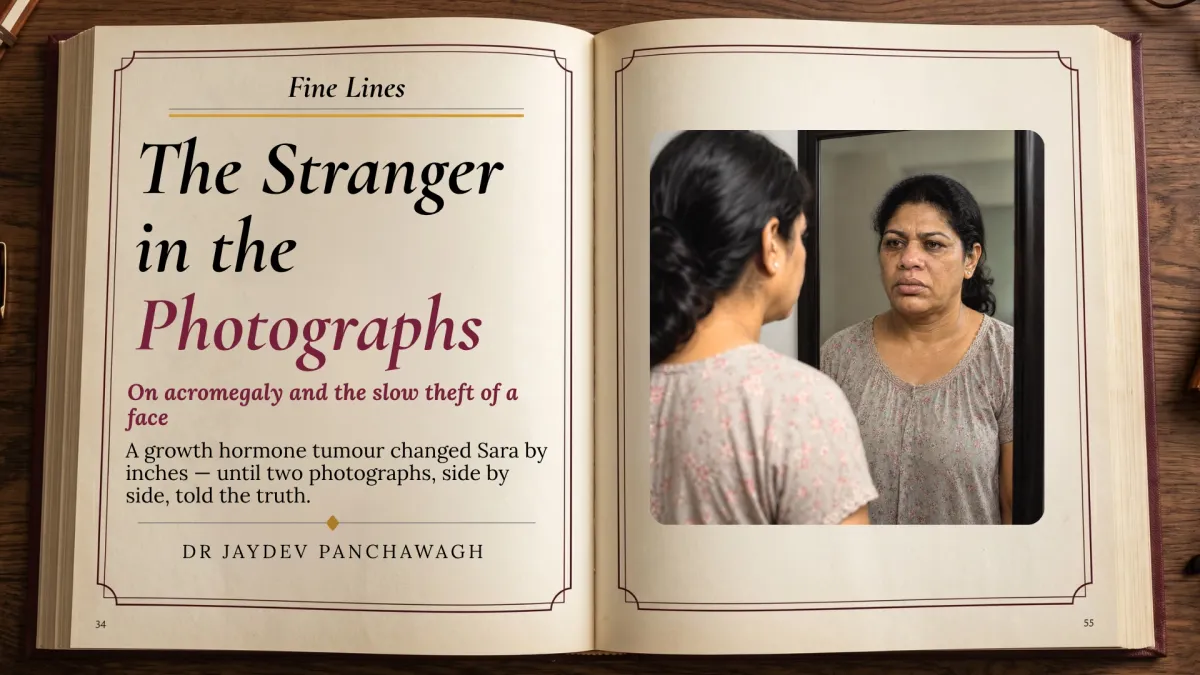
The Stranger in the Photographs
How gradual facial changes may be linked to acromegaly and a pituitary tumour.
Read More →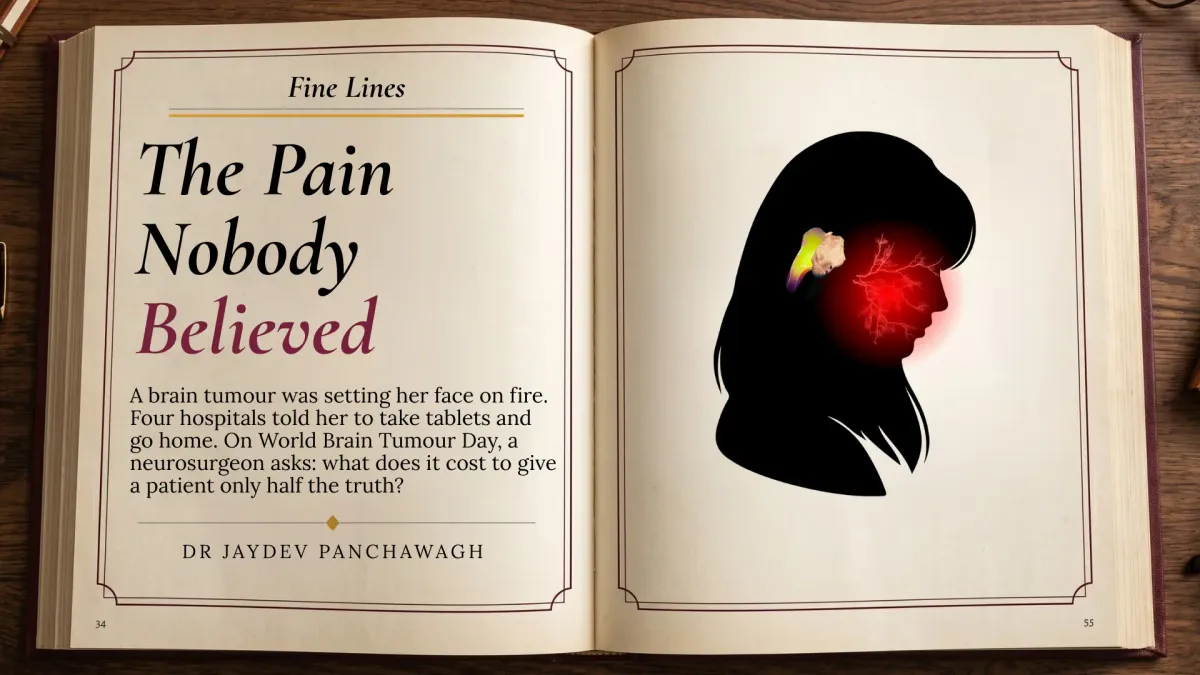
The Pain Nobody Believed
A story about severe facial pain, diagnosis and the importance of looking for its underlying cause.
Read More →
The Body Speaks First
Reflections on the relationship between the brain, body and mind, and the role of movement and breath.
Read More →Watch Related Videos
Explore more videos from Dr. Jaydev Panchawagh covering neurosurgery, brain health and related medical topics.