
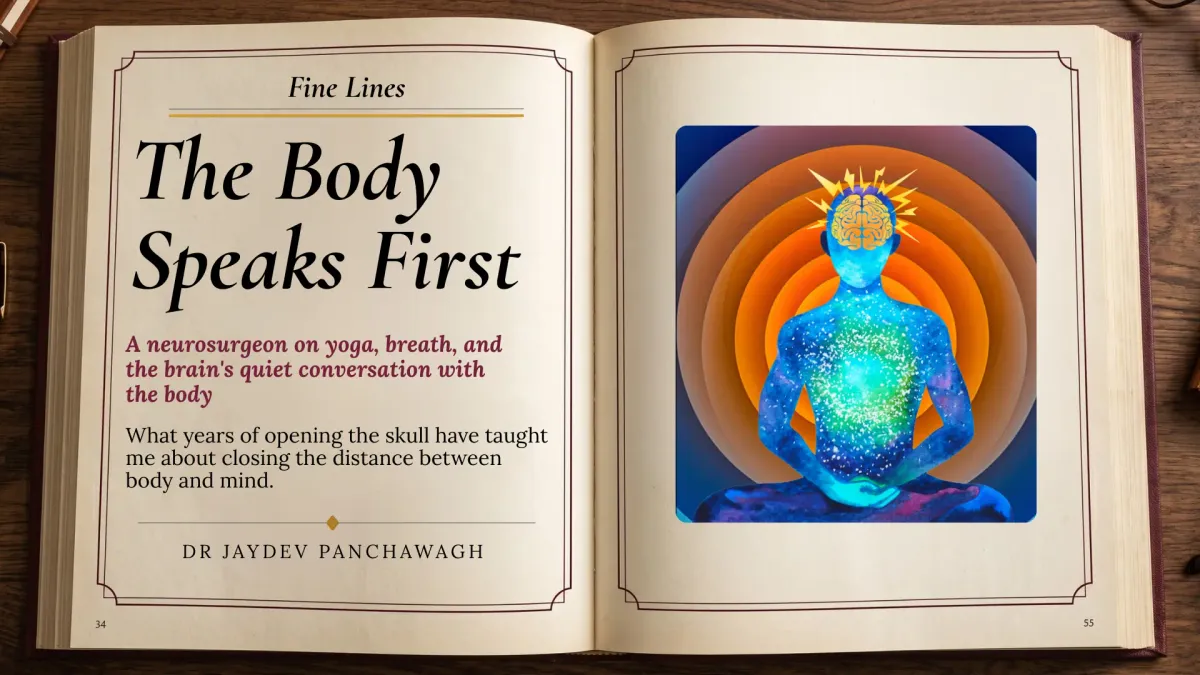
I have spent much of my working life looking directly at the brain. Under the microscope it does not look like a mind. It is tissue — pale, glistening, threaded with vessels and neurons finer than hair. Somewhere in that tissue lives everything a person is: memory, grief, the capacity for joy, creativity and a sense of self.
The person who walks into my clinic and the organ I later examine are the same. One is integrated into the other, yet sometimes they can feel different. This gap, between the felt self and the physical organ, is where yoga, exercise and breath do their quiet work. It is also where much of modern brain-health research now lives.
What Neurosurgery Teaches About the Mind
The brain is responsive.
Neurosurgery teaches humility about this gap. I have operated on brains that looked structurally identical under the microscope and yet belonged to people living entirely different inner lives. Anatomy alone does not explain temperament, resilience or despair. Somewhere between the wiring and the person, physiology and psychology cross paths continuously, often invisibly.
This is not new knowledge. Long before imaging could show a hippocampus changing shape or a vagus nerve firing, yogis had observed through daily practice that the body was never separate from the mind. Modern neuroscience is continuing to investigate the connections they explored through experience and discipline.
The Two-Way Street: Psychosomatic and Somatopsychic
The mind moves the body. The body moves the mind back.
Many actions — conscious and subconscious — are psychosomatic: the mind acts on and influences the body. Anxiety can tighten the chest. Grief can exhaust the limbs. Chronic stress can affect stress-hormone activity and, over time, influence how the brain functions and adapts.
The reverse direction, somatopsychic, receives less attention, though it matters too. The body also acts on the mind. A sedentary routine may accompany a lower mood, while regular movement — through yoga, walking, swimming or other sustained activity — can support emotional well-being.
Body and mind are not two systems talking to each other. They are one system, described in two languages.
Movement can change blood flow, influence circulating hormones and affect autonomic nervous-system activity. The vagus nerve, which links the brain with organs including the heart, lungs and digestive system, is part of this ongoing two-way communication.
Yoga, Exercise and the Ageing Brain
Time asks a question of every brain. Movement is one honest response.
Research increasingly suggests that people who remain physically active through midlife and later life tend to show better preservation of brain health, including areas involved in memory such as the hippocampus. Regular aerobic activity is associated with higher levels of brain-derived neurotrophic factor, or BDNF, a protein involved in the survival and growth of neurons.
Physical activity is also linked with neuroplasticity — the brain's ability to keep forming and adapting connections across life. Studies have found associations between sustained activity, including yoga-based movement, and a lower risk of cognitive decline in later life.
It is important to be precise: association is not proof of prevention. No form of exercise, yoga included, guarantees protection against dementia. The evidence supports potential benefits for brain health, function and quality of life, not a promise that disease can be prevented.
Breath as the Body's Oldest Medicine
Of the body's involuntary functions, breath is one we can consciously influence.
Breathing is unusual among bodily functions. We cannot directly will the heart to slow in the same way, but breath sits at the border of voluntary and involuntary control. Yogic traditions recognised this and developed disciplined practices around it.
Slow, controlled breathing may increase parasympathetic activity, supporting the body's rest-and-recovery response and influencing heart rate. These effects are being studied through measures such as heart-rate variability and brain imaging.
Pranayama need not be framed as mysticism. It is a traditional breathing practice that can be understood, in part, through the nervous system. It should be practised comfortably and adapted to individual needs; it is not a substitute for medical care.
Happy Hormones
Movement does not cure sadness. It can support well-being.
Physical activity influences several chemical messengers involved in mood, including endorphins, serotonin and dopamine. Regular movement is associated with lower rates of depression and anxiety and may be a useful part of a broader treatment plan.
Exercise is not a cure for depression or anxiety, and it should not replace prescribed medication or professional therapy. For some people, it can be a valuable adjunct, practised gently and consistently alongside appropriate care.
A Closing Thought
Today we have machines that reach into the nervous system to calm or train a mind that will not calm itself, or to help a body move. We are proud of these machines, and we should be.
I did not train as a philosopher, only as a surgeon who has spent enough hours inside the skull to develop respect for what lies outside it. The breath is a useful tool. It needs no machine, appointment or wires. It asks only to be practised regularly and consistently, within one's own capacity.
That is one inheritance of the old yogis. Not a cure, and not a substitute for medicine when medicine is needed. Just a tool for ordinary days and difficult ones. The body and the mind have always been in conversation. We are learning to listen more carefully.
Breathe. Observe. Move. Transform yourself.
Continue Reading
The Body Speaks First
Reflections on yoga, breath and the relationship between the brain, body and mind.
Read More →
Eros in the Brain
A reflection on the brain, neuroscience and the connections between human experience and biology.
Read More →
The Weight We Have Chosen to Carry
On volume, consistency and what a high-volume neurosurgery centre is actually for.
Read More →Watch Related Videos
Explore more videos and educational content from Dr. Jaydev Panchawagh on brain health, neurosurgery and related topics.


