

We spend our lives learning to read faces without being taught. A raised eyebrow. A flicker at the corner of the mouth. Long before Darwin wrote The Expression of the Emotions in Man and Animals and catalogued the muscles that betray us, humans already knew that the face speaks a language older than words. It is why an actor can hold a stage with nothing but stillness, and why a single twitch, in the wrong moment, can undo an entire sentence.
Most of us assume the face obeys us. It does — mostly. But there is a small, stubborn category of movement the face makes entirely on its own. A wink that isn’t a wink. An eye that closes when nothing has asked it to. For most people this passes in seconds, a minor mutiny, forgotten by lunch.
For a woman I will call Meera, it did not pass. It had been happening for six years.
A Twitch Called Hemifacial Spasm
A flicker at the corner of the eye, and the years it took to be taken seriously
Meera arrived at my clinic with her husband, a folder of prescriptions, and a habit she had developed without noticing — angling her face slightly away from whoever she was speaking to, so the left side, the side that moved, stayed out of view.
It had started small. A flutter near the eye, the kind everyone gets after too little sleep or too much coffee. Hers did not go away. Over months, it spread — from the eyelid down to the cheek, then to the corner of the mouth, until one side of her face was, in her own words, “doing its own thing.”
This is Hemifacial Spasm — involuntary, irregular contractions on one side of the face. In many cases, it is associated with a blood vessel compressing or irritating the facial nerve near its exit from the brainstem. Before we reached that word, Meera had been told it was stress. Then eye strain. Then, gently, that it might be anxiety, and had she considered speaking to someone.
None of this is unusual. Hemifacial Spasm can go unrecognised for years, mistaken for a tic, a psychological symptom, or the ordinary wear of a stressful life, because on the surface, a twitch looks like nothing at all. It takes a particular kind of attention to notice that the twitch is not behaving like an ordinary one — that it may persist, spread across one side of the face, and continue despite rest.
Darwin argued that facial expression is not learned, but wired into us before birth, shared across cultures and species. He never imagined that in a few people, that same wiring could misfire — not from emotion, but from a blood vessel resting somewhere it shouldn’t.
The Surgery Behind It: Microvascular Decompression
Where the trouble actually begins — not in the face, but deep behind it
The facial nerve does not begin at the face. It begins at the brainstem, deep at the base of the skull, where it exits as a thin, pale thread no thicker than wet string.
In Hemifacial Spasm, a blood vessel — often a small branch of an artery supplying the brainstem — may come to rest against this nerve, near the point where it leaves the brain. This vessel does not sit still. It pulses, once with every heartbeat, thousands of times a day, making repeated contact with the nerve.
Oliver Sacks would have recognised the shape of this story immediately — a case where the villain is not a disease in the usual sense, but a heartbeat in the wrong place. His book The Man Who Mistook His Wife for a Hat is full of cases that show how the nervous system can misfire in small, specific ways. Each patient is stranger, and more human, than any textbook entry could make them. Hemifacial Spasm belongs on that shelf.
Over months and years, repeated contact between a vessel and the nerve may irritate nerve fibres, contributing to abnormal signals to the facial muscles that the brain never intended. The twitch a person sees in the mirror can be understood as an echo of their own pulse.
The operation used in appropriately selected cases — Microvascular Decompression (MVD) — aims to relieve this pressure. Under an operating microscope, the surgeon identifies the vessel and carefully separates it from the nerve. A small piece of Teflon, an inert cushioning material, may be placed between them to help maintain that separation.
Nerve monitoring may be used during the procedure to help the surgical team assess nerve function. The precise technique and operative findings vary with each patient’s anatomy and the cause of compression.
For patients experiencing other forms of nerve-related facial pain, Trigeminal Neuralgia is another condition that may require specialist assessment.
The compression that had been running quietly beneath her skin for six years is separated from the nerve. The spasm has a physical explanation — and, for appropriately selected patients, surgery may address that cause.
Some patients notice a change in their spasms during or soon after surgery, while for others improvement may take longer. Outcomes vary, and no particular result can be guaranteed. The potential benefits, alternatives and risks should be discussed with the treating neurosurgeon.
Recovery After Microvascular Decompression
What it means to look straight into a camera and recognise every part of what looks back
Meera kept one photograph from before the surgery, tucked at the back of a drawer. It was from a wedding, taken three years into the spasm. She is standing at the edge of the frame, half turned, her chin dropped just enough to catch the light differently. Nobody else in the photograph is doing this. She remembers exactly why she did.
For six years, every photograph was a small negotiation: which angle, how much light, whether to laugh with her mouth closed.
Her husband had made calls, and visited other doctors, before they ever came to me — comparing notes on where this surgery was done well, weighing how much confidence he felt each time he spoke with a neurosurgeon. He told me about it only after Meera’s surgery, at a follow-up visit, almost in passing. Once they had decided whom to trust with her MVD, he said, they stopped thinking and simply followed instructions.
Recovery after MVD is individual. The treating team provides guidance on wound care, medication, activity and follow-up appointments. The timing of a return to work and normal routines depends on the patient’s recovery and should be discussed with the treating team. Any new or worsening symptoms after surgery should be reported promptly.
The muscles of the face are not like other muscles. We use them to signal, to warn, to invite. A stranger reads them in half a second and decides something about us before we speak. For six years, Meera’s face had been sending a signal she never intended — read by strangers as a wink, a smirk, something private and misplaced. After surgery, it stopped. In every photograph since, her face says only what she means it to say.
Names and identifying details have been changed to protect patient privacy. Shared with the patient’s consent.
Continue Reading
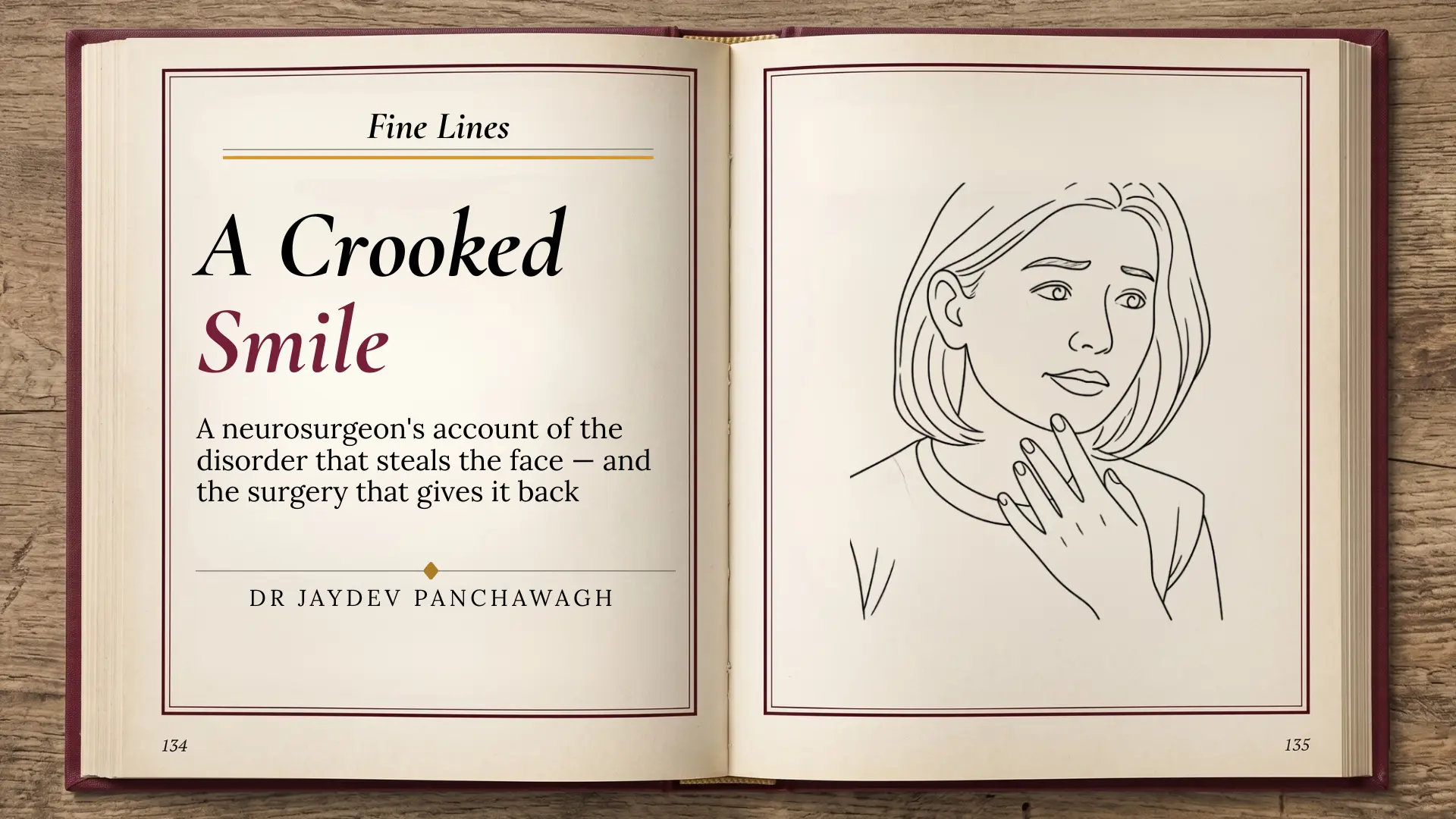
A Crooked Smile
A story about facial movement, nerve function and the role of neurosurgical assessment.
Read More →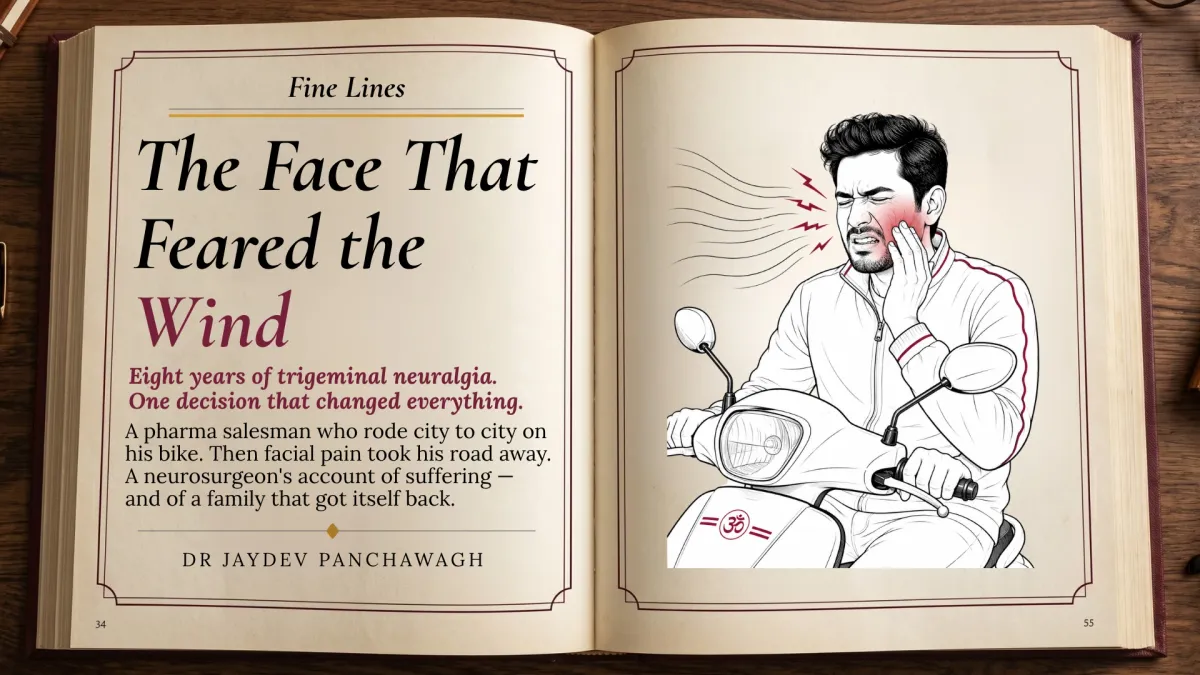
The Face That Feared the Wind
Eight years of Trigeminal Neuralgia, one decision that changed everything, and the role of MVD surgery.
Read More →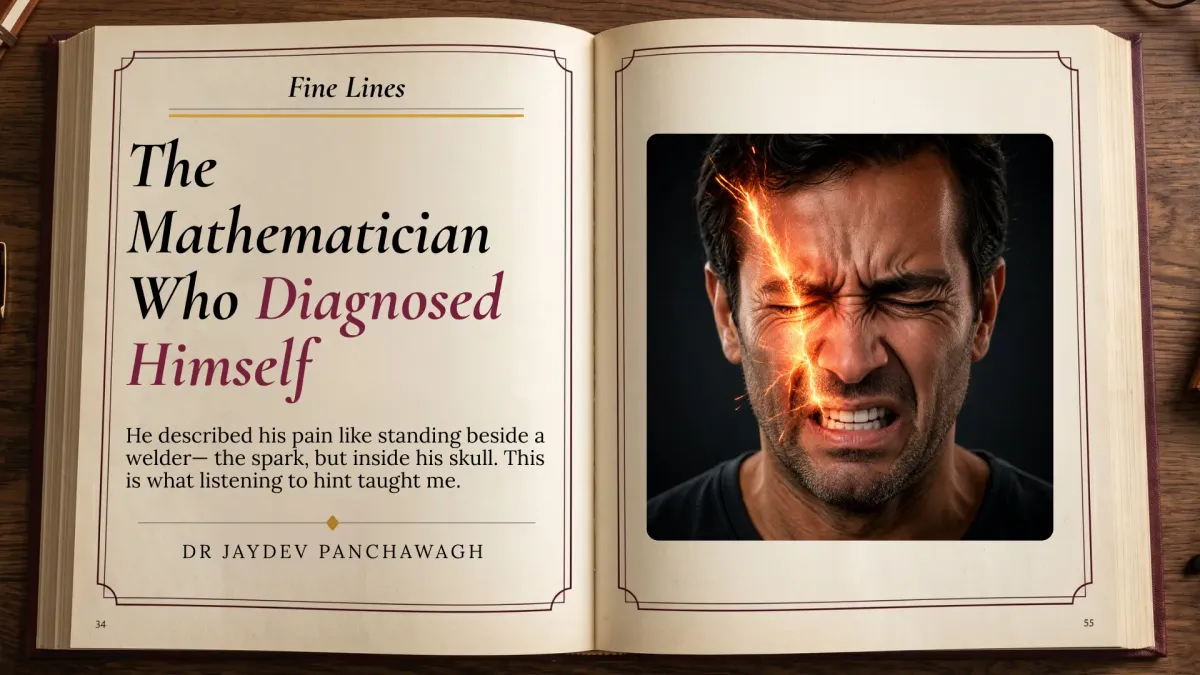
The Mathematician Who Diagnosed Himself
A patient's unusual description of facial pain and the importance of recognising patterns.
Read More →Watch Related Videos
Explore more educational videos about facial nerve conditions, neurological symptoms and neurosurgical treatment options.


