Beyond Words: How Art Helps Us Learn
We tend to think of learning as reading textbooks and memorizing facts. But Dr. Panchwagh reminds us that the best knowledge often bypasses our typical logic pathways.
“Symbols have the ability to bypass the tedious path of logic and even words… the drawing symbolism delivers the complex concepts directly.”
He suggests that painting and drawing connect us to knowledge on an emotional, intuitive level—what he calls “direct knowledge.” Think of those moments when you just know something, but can’t explain how. That’s the power of this direct, artistic approach, and it’s invaluable in high-stakes surgery. For a neurosurgeon, being an artist isn’t just a fun hobby; it’s a way to achieve a deeper, faster understanding of complex scientific principles.
A Powerful Window for Learning
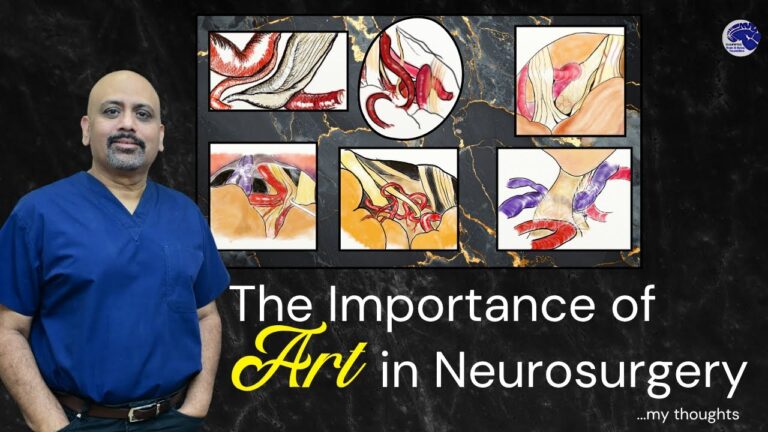
While Dr. Panchwagh acknowledges that photography is useful, he champions the act of drawing as a superior way to document and truly learn from a surgery.
Why? Because when you’re operating, your focus is laser-sharp—you’re only seeing the tiny area that matters most. When you sit down later to draw the surgery:
You’re forced to look at every detail. You can’t leave anything out. This minute attention acts as an incredibly powerful review window.
The tension is gone. Reviewing recordings and sketching allows the surgeon’s mind to be in a more meditative state, free from the life-and-death stress of the moment.
This mindful recreation of the surgery helps solidify new information and reveal details that were missed during the procedure.
The Breathtaking View from the Neuro Microscope
Imagine a world humanity never saw until modern science: the deep, hidden structures of the brain, illuminated by a microscope or endoscope.
Dr. Panchwagh describes this view as absolutely mesmerizing. It’s a spectacular interplay of light, shadow, texture, and color—a genuinely surreal perspective.
What makes this artistic bounty so unique is what you’re looking at: the centers of all human ability—thought, memory, emotion, breath control.
“You are looking at not only the nature’s functional marvel, but the best of aesthetic attributes… This has been made possible by the light shown inside by a neuro microscope or a neuroendoscope.”
In his view, this fusion of Mother Nature’s greatest functional masterpiece with the profound beauty of light and form makes neurosurgical drawing an almost superior form of art. It speaks to our deep, ingrained human desire for visual art, the same hunger that drove our ancestors to create cave paintings.
Dr. Panchwagh’s message is a wonderful invitation to see science, and particularly neurosurgery, not just as a job, but as an opportunity for aesthetic enrichment. It’s a call for surgeons to appreciate the art in their blood and connect with the immense beauty that unfolds before them daily.
This artistic appreciation can relieve stress, spark new scientific ideas, and, most importantly, provide a deeper, more meaningful connection to the vital work they do.






Leave a Reply